
How Regulators Review Drug Brand Names: US, EU, & Japan
June 11, 2026

A proprietary brand name can accelerate a global launch or quietly derail it. Across the US, EU, and Japan, regulators evaluate brand names not as marketing assets, but as patient‑safety controls. Differences in legal frameworks, linguistic expectations, and review timing mean that a name acceptable in one region may face rejection in another, often late in development, when remediation options are limited.
This edition of PharmaFocus examines how the U.S. Food and Drug Administration (FDA), the European Medicines Agency (EMA), and Japan’s Pharmaceuticals and Medical Devices Agency (PMDA) assess proprietary names, where sponsors most often encounter regulatory friction, and how a structured, early naming strategy can reduce approval risk across major markets.
Why Brand Name Strategy Matters
Brand name selection is a critical regulatory milestone that affects patient safety and time to market. Medication errors from name confusion are a public health issue: the FDA documents ~100,000 error reports annually, with name confusion accounting for ~15% of incidents.
The financial stakes are high—large pharma invests $1–3M in naming a single global brand. A regulatory rejection forcing a restart can extend timelines by 1–2 years. In July 2025, the FDA published over 200 Complete Response Letters (CRLs) issued between 2020 and 2024, highlighting naming deficiencies as a common rejection cause.
BLA Regulatory Perspective: Treat brand name development as integral to the regulatory dossier, not a parallel commercial workstream.
United States: FDA’s Proprietary Name Review
Regulatory Framework and Review Process
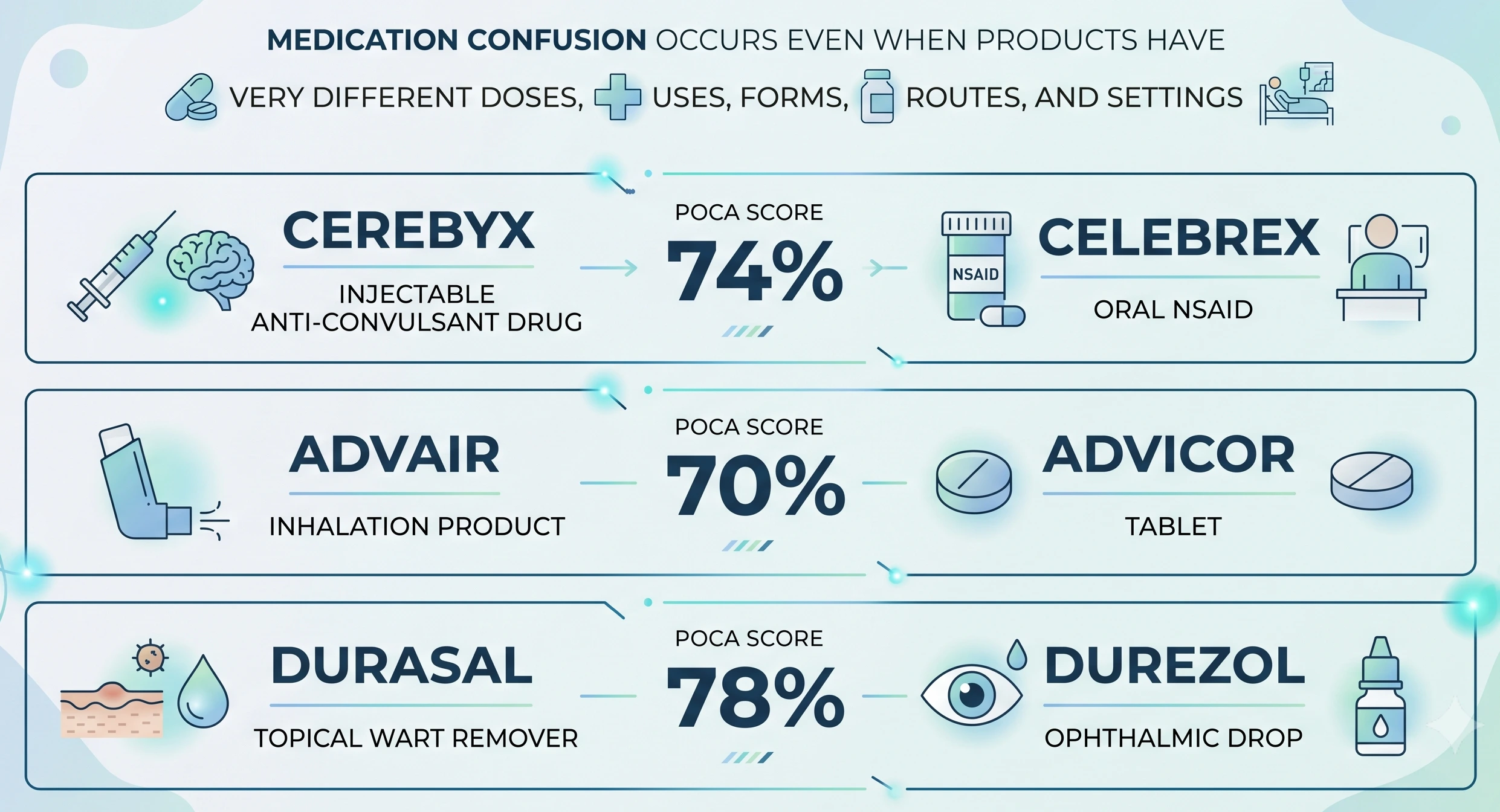
The FDA’s review is performed jointly by Office of Prescription Drug Promotion () (evaluates false/misleading claims) and Division of Medication Error Prevention and Analysis (DMEPA) (evaluates medication error risk). DMEPA uses the Phonetic and Orthographic Computer Analysis (POCA) algorithm to compare proposed names against marketed drugs, generating similarity scores to support risk assessment.
While final clearance is a holistic evaluation, the FDA categorizes candidates into strict risk tiers based on their objective POCA score, as outlined in the FDA Best Practices Naming Guidance (Dec 2020) and analyzed in the Troutman Pepper POCA Tier Analysis:
-
- High Similarity (Score ≥ 70%): Rejections are highly probable unless product traits (such as completely non-overlapping clinical settings of use) entirely separate them (e.g., a topical cream vs. an oncology infusion).
- Moderate Similarity (Score 50% to 69%): Names in this range trigger deep secondary evaluations, where the FDA heavily weighs data from prescription simulation studies to see if the name is easily misread under stress.
- Low Similarity (Score ≤ 49%): Typically cleared smoothly unless unique variables (like a highly unusual overlapping dose expression) flag an independent safety concern.
DMEPA also queries these scores against Drugs@FDA and
Historical precedents demonstrate how high POCA scores fail in practice.
Submission Timing
Proprietary name review requests may be submitted during the IND phase, following EOP2 interactions, or during Phase 3 development. Requests can also be submitted with the original NDA or BLA submission. The review timeline is 180 days if submitted to the IND vs 90 days for NDA/BLA.
Strategic Recommendations:
- Conduct in-silico Look-Alike, Sound-Alike (LASA) screening using tools similar to POCA.
- Perform simulated prescription studies under stress or distraction.
- Assess container label designs.
- Advance at least two fully vetted backup names.
- FDA strictly prohibits incorporating United States Adopted Names (USAN) stems in the position designated for that stem within a proprietary brand name. Doing so is viewed as misleading and error-prone because it can falsely imply a specific chemical or pharmacological mechanism of action. Per the FDA Best Practices Naming Guidance, the agency will only allow two-letter stem matches if they are entirely coincidental and have zero clinical overlap with the established stem’s traits.
Post-Marketing Considerations
DMEPA continues monitoring name-related confusion; FDA may require a name change post-launch if safety issues emerge.
European Union: The Centralised Procedure and the Name Review Group
Regulatory Framework
For products via the Centralised Procedure, the Name Review Group (NRG), a satellite group of the Committee for Medicinal Products for Human Use (CHMP), reviews the invented name. Governing guideline: EMA/CHMP/287710/2014 Rev. 7 (effective 1 Jan 2024). This revision clarifies the Name Review Group’s assessment criteria, including structured checks for misleading claims, confusion risk, and use of International Nonproprietary Name (INN) stems.
Multilingual Safety Assessment
The NRG assesses the name across 24 official EU languages. A name that seems harmless in English may be misleading elsewhere. While the guideline highlights heightened concern when invented names incorporate substantial portions of INN stems, acceptability remains a case‑by‑case determination rather than a rigid quantitative rule.
Procedural Nuances
- NRG review occurs during Marketing Authorisation Application (MAA) evaluation. A negative opinion can trigger a clock-stop.
- Applicants may submit up to two invented names (in order of preference).
- NRG meets new names per meeting (first-come, first-served).
- Submit a name review request once CHMP confirms eligibility (typically 7-18 months before MAA submission).
Strategic Recommendations
- Front-load multilingual LASA screening and native-speaker connotation testing for all major EU languages.
- Use the two-name allowance strategically: primary name for pan-EU consistency, secondary to mitigate a specific high-risk objection.
- Engage EMA via a pre-submission meeting to discuss naming strategy.
Japan: PMDA and the Katakana Imperative
Regulatory Framework
The brand name is reviewed by the PMDA under Ministry of Health, Labour and Welfare (MHLW) authority. A defining requirement: the name must be written in katakana (phonetic syllabary for foreign loanwords). This introduces strategic issues of phonetic transcription, visual similarity to existing products, and pronunciation accessibility for Japan’s elderly population.
PMDA Review Criteria
The PMDA’s review centers on whether the name:
- Misleads by suggesting exaggerated efficacy or a specific unapproved indication.
- Could cause confusion with existing Japanese or international products.
- Inadvertently forms a real Japanese word with negative or unintended connotations when transcribed into katakana.
Japan adheres to the Common Technical Document (CTD) structure with Japanese-specific conventions (J-CTD). Module 1 requires application forms, Marketing Authorization Holder (MAH) info, Good Manufacturing Practice (GMP)/ Good Quality Practice (GQP) documents, and Japanese-language labeling with strict character-level consistency.
Strategic Recommendations
- Engage Japanese-speaking regulatory/linguistic experts early (ideally Phase II).
- Generate multiple katakana candidate transcriptions; screen for phonetic euphony, negative semantic associations, and visual similarity to other katakana names in PMDA database.
- Recognize that a globally optimal name may need strategic adaptation for Japan while maintaining a recognizable link to the global brand.
Conclusion
A strong global brand name strategy must balance commercial branding goals with the strict safety requirements across the three regions. The days of treating the brand name as a last-minute marketing decision are over.
Sponsors who integrate naming into the regulatory dossier from Phase II, invest in region-specific safety testing, and maintain flexibility across naming candidates will transform a source of regulatory risk into a strategically sound, approvable asset that accelerates global patient access.
How BLA Regulatory Can Help
BLA Regulatory supports sponsors in navigating proprietary name risk as part of the regulatory development strategy. We work with cross‑functional teams to assess name acceptability across the US, EU, and Japan, prepare regulator‑ready proprietary name submissions, and address name‑related questions during review.
Our focus is on aligning naming decisions with patient‑safety expectations, regulatory timelines, and global submission pathways.
Contact BLA Regulatory today to discuss how we can support your global brand name strategy.
References
- FDA, Phonetic and Orthographic Computer Analysis (POCA) Program
- FDA, Guidance for Industry: Contents of a Complete Submission for the Evaluation of Proprietary Names
- EMA, Guideline on the acceptability of names for human medicinal products processed through the centralised procedure
- EMA, Mandate, objectives, and rules of procedure for the Name Review Group
- CMS Law, What’s in a name? Updated EMA guideline on naming medicinal products processed through the centralised procedure comes into effect
- PMDA, Review Reports: Drugs
- PMDA, PMDA Medical Safety Information No. 69: Name-Similarity Medication Errors
- org, Double Trouble: Consumer Awareness of Look-Alike Names is Critical for Drug Safety
- Corsearch, Streamlining Pharma Name Clearance: Unified Trademark and Regulatory Review
- DrugPatentWatch, Pharmaceutical Drug Naming: The Complete IP, Patent, and Brand Strategy Guide
- Brandsymbol, The Hidden Costs of Poor Pharma Naming Management
- BioPharma Dive, FDA, in policy shift, publishes some drug rejection letters
- EUPATI, EU Regulatory Procedures for a Marketing Authorisation
- in, Common Challenges Faced by Foreign Applicants in Japan: PMDA-Ready Dossiers, Governance, and Execution
This newsletter is for informational purposes only and does not constitute formal legal or regulatory advice.