
U.S. FDA Cleared, But Is Your Medical Device Reimbursement-Ready?
August 13, 2026

FDA marketing authorization is a critical milestone in the development of a medical device, but it is only one component of market access. While authorization allows a device to be legally marketed in the United States, it does not determine whether healthcare providers will be reimbursed for using it.
Reimbursement decisions are made independently by the Centers for Medicare & Medicaid Services (CMS), Medicare Administrative Contractors (MACs), state Medicaid programs, and commercial health insurers. These organizations determine whether a device or the associated healthcare service is covered, how it is billed, and how providers are paid. Because regulatory authorization and reimbursement serve different purposes, manufacturers should address both early in product development to reduce commercialization risk and support provider adoption.
FDA Authorization and Reimbursement: Distinct Roles
FDA and healthcare payers evaluate many of the same medical technologies, but they apply different standards and answer different questions.
FDA determines whether a medical device satisfies the statutory and regulatory requirements for marketing. Depending on the regulatory pathway, this may involve demonstrating substantial equivalence to a legally marketed predicate device through the 510(k) process, supporting De Novo classification for a novel low- to moderate-risk device, or providing reasonable assurance of safety and effectiveness through Premarket Approval (PMA).
Healthcare payers evaluate whether a device or the associated healthcare service qualifies for reimbursement under their coverage policies. Their decisions generally consider whether:
- the item or service falls within a covered benefit category;
- applicable coverage requirements have been met, including Medicare’s statutory “reasonable and necessary” standard or comparable commercial medical necessity criteria;
- sufficient clinical evidence supports use in the intended patient population;
- appropriate billing codes are available; and
- existing payment methodologies adequately support provider use.
These decisions are independent of FDA marketing authorization. A device may receive FDA authorization yet still face reimbursement challenges if appropriate coverage, coding, or payment mechanisms have not been established.
The Three Components of Reimbursement
Medical device reimbursement is commonly described through three interrelated components: coverage, coding, and payment. Although closely connected, each serves a distinct purpose.
💡Payer Primer: Medicare, Medicaid, and Commercial Insurance
-
-
- Medicare is the federal health insurance program primarily serving individuals aged 65 and older and is administered by CMS.
- Medicaid is a joint federal-state program, with coverage policies and reimbursement rules that vary by state.
- Commercial insurers are private health plans that develop their own coverage policies and medical necessity criteria.
-
Coverage
Coverage determines whether a payer will reimburse a device or the associated healthcare service under specified clinical circumstances. Coverage policies may define patient eligibility, covered indications, documentation requirements, and other conditions for reimbursement.
For Medicare, coverage may be established nationally through a National Coverage Determination (NCD) or locally through Local Coverage Determinations (LCDs) issued by Medicare Administrative Contractors (MACs). When neither exists, MACs may make claim-by-claim determinations based on Medicare statutes, regulations, and program guidance.
Commercial insurers develop their own coverage policies, while Medicaid coverage is administered by individual states within federal requirements. Consequently, coverage criteria often vary among payers.
Coding
Coding establishes how a device or healthcare service is reported on a claim using standardized billing codes.
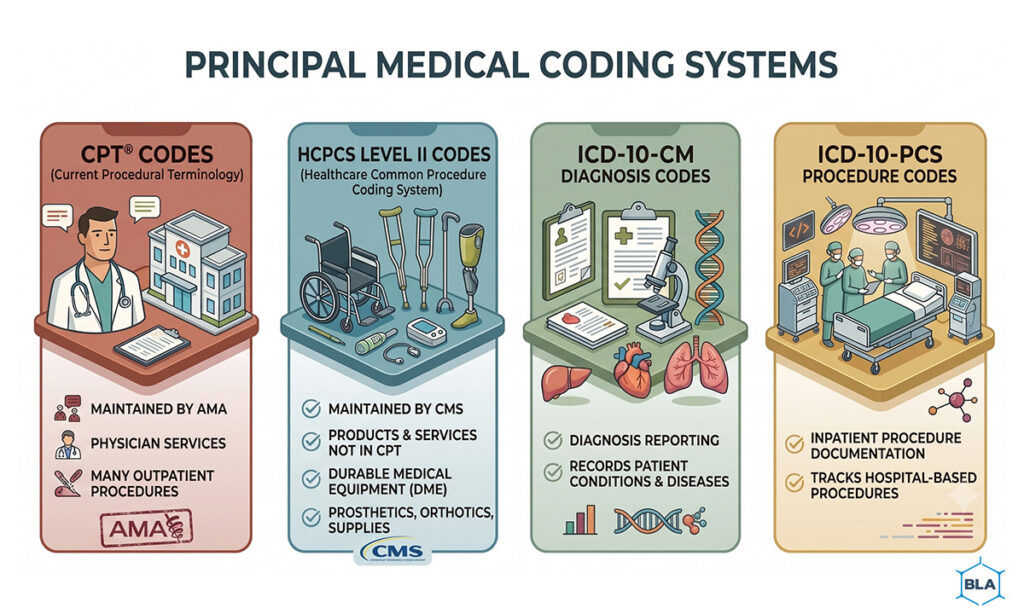
The appropriate coding strategy depends on the technology, intended use, and site of care. When existing codes do not adequately describe an innovative technology, manufacturers may seek new or revised codes through the appropriate coding authority. Although coding is essential for claims submission, it does not establish coverage or guarantee payment.
Payment
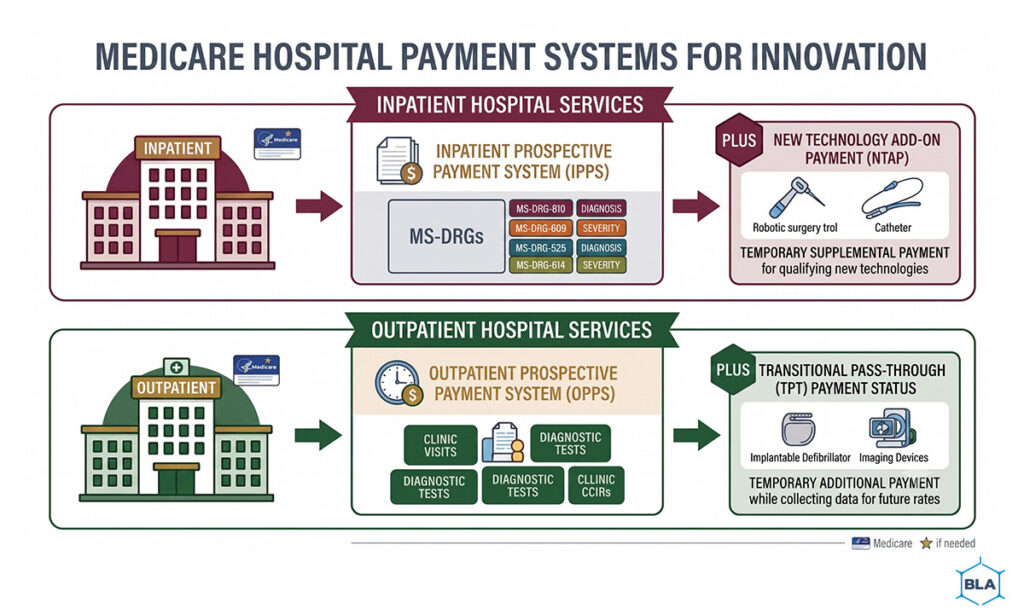
Payment determines how providers are reimbursed once applicable coverage and coding requirements have been met. Payment methodologies vary significantly based on the site of care. Manufacturers should understand where a device is expected to be used because payment policies and provider incentives may differ across inpatient hospital, hospital outpatient department, ambulatory surgery center, physician office, or home care settings.
Under Medicare’s prospective payment systems, reimbursement for many devices is bundled into payment for the overall episode of care rather than paid separately. As a result, payment adequacy can significantly influence provider adoption, particularly for innovative technologies whose costs are not yet reflected in existing payment rates.
Evidence Generation and Early Planning
Beyond coverage, coding, and payment considerations, manufacturers must also consider whether their clinical evidence will satisfy payer expectations. The evidence supporting FDA marketing authorization may not fully satisfy payer expectations for coverage.
FDA evaluates devices according to the statutory standard applicable to the regulatory pathway. Healthcare payers may also consider comparative clinical effectiveness, durability of benefit, real-world utilization, and evidence demonstrating meaningful improvements in patient outcomes. Payers may also consider economic evidence, including the potential impact of a technology on healthcare utilization, resource use, and overall cost of care. Consequently, manufacturers may benefit from incorporating reimbursement considerations into clinical development rather than addressing them after FDA authorization.
To support earlier evidence planning, the FDA Center for Devices and Radiological Health (CDRH) offers the Early Payor Feedback Program (EPFP), which allows manufacturers to obtain voluntary feedback from participating public and private payers on proposed clinical study designs and evidence generation strategies.
CMS has also introduced initiatives intended to improve the predictability of Medicare coverage for certain innovative technologies. The Transitional Coverage for Emerging Technologies (TCET) pathway established a structured approach to Medicare coverage for eligible FDA-designated Breakthrough Devices through the National Coverage Determination process and, where appropriate, Coverage with Evidence Development (CED).
In April 2026, FDA and CMS announced the Regulatory Alignment for Predictable and Immediate Device (RAPID) Coverage Pathway, which seeks to better coordinate FDA premarket review and Medicare national coverage review for eligible Breakthrough Devices. As RAPID is implemented, CMS has announced that TCET is currently paused for new candidates. These initiatives are intended to improve coordination between regulatory review and reimbursement planning while preserving the separate roles of FDA and CMS.
Reimbursement in Practice
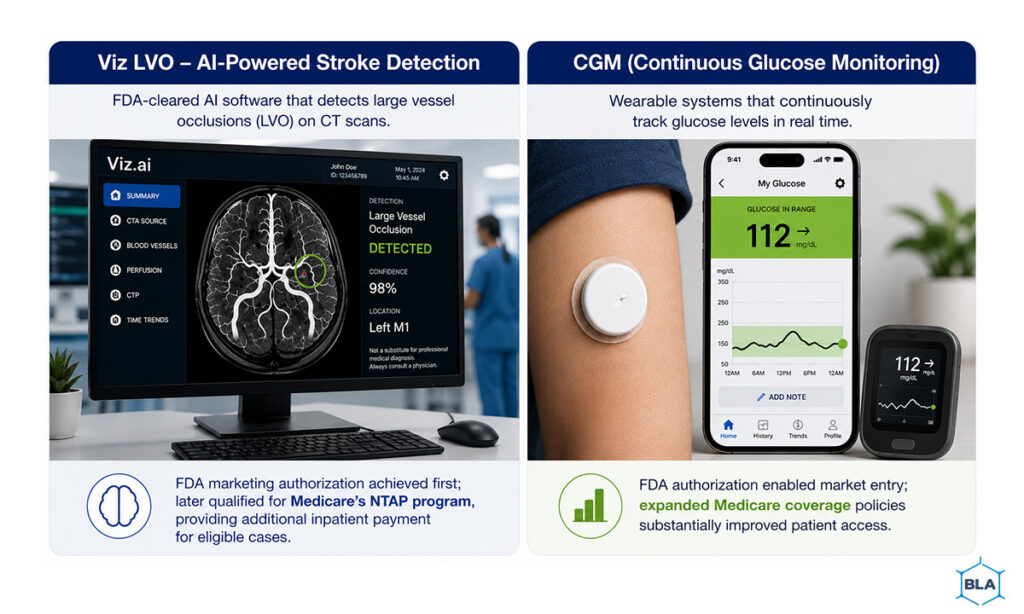
The distinction between FDA marketing authorization and reimbursement is reflected in the commercialization of many innovative medical devices. For example, Viz LVO, an AI-based stroke detection software, received FDA marketing authorization before subsequently obtaining Medicare’s New Technology Add-on Payment (, highlighting how reimbursement pathways may evolve after regulatory authorization. Similarly, continuous glucose monitoring (CGM) systems achieved broader patient access as Medicare expanded coverage policies over time. Other technologies have been reimbursed through Coverage with Evidence Development (CED), which links Medicare coverage to the collection of additional clinical evidence.
Conclusion
FDA marketing authorization may open the door to the U.S. market, but reimbursement often determines whether a technology achieves meaningful adoption in clinical practice. Manufacturers that evaluate coverage, coding, payment, and evidence requirements early are better positioned to navigate market access challenges and support long-term commercial success. A coordinated strategy across regulatory, clinical, reimbursement, health economics and outcome research (HEOR), medical affairs, and commercial functions can help organizations anticipate payer expectations, reduce uncertainty, and bring innovative technologies to patients more effectively.
Insights from the MedTech Guru
Q: My device received FDA marketing authorization. Why are hospitals still hesitant to adopt it?
A: FDA marketing authorization allows a device to be legally marketed but does not guarantee reimbursement. Without appropriate coverage, coding, and payment, hospitals may be reluctant to adopt even clinically valuable technologies.
Q: Can reimbursement influence my clinical trial design?
A: Yes. Clinical studies designed solely to support FDA marketing authorization may not generate the evidence payers require for coverage decisions. Incorporating reimbursement objectives early can strengthen market access.
Q: Can I commercialize my device without a new billing code?
A: Yes. Many devices launch using existing billing codes. The key is whether available codes accurately describe the technology and support appropriate reimbursement.
Q: Can a medical device be commercialized in the U.S. without reimbursement?
A: Yes. FDA marketing authorization allows a device to be legally marketed regardless of reimbursement status. Some devices are successfully commercialized through direct patient payment, although reimbursement is often essential for widespread adoption of technologies used in routine clinical care.
Upcoming Events – August 2026
India Health 2026. August 21–23, 2026, Hall 6, Bharat Mandapam, New Delhi.
Leading healthcare exhibition and conference presented by Informa Connect and the organizers of WHX Dubai (formerly Arab Health), focused on healthcare innovation, medical technologies, industry trends, strategic insights, networking, collaboration, and advancing healthcare through global partnerships and knowledge exchange. India Health 2026
MEDevice Boston 2026. August 26–27, 2026, Thomas M. Menino Convention and Exhibition Center, Boston.
Premier medical device industry event focused on device design, development, manufacturing, quality, regulatory affairs, MedTech innovation, product commercialization, supply chain solutions, and networking among engineers, executives, startups, and industry leaders across the medical technology ecosystem. MEDevice Boston 2026
How Can BLA Regulatory Help?
BLA Regulatory, LLC operates as a global regulatory consulting firm specializing in medical device and biopharmaceutical compliance and submission support. Our medical device reimbursement experts help manufacturers develop integrated coverage, coding, and payment strategies, align clinical evidence with payer expectations, and navigate complex reimbursement pathways. We help manufacturers develop integrated reimbursement strategies that reduce market access risk and accelerate commercialization. BLA Regulatory serves clients across the U.S., Europe, China, and Japan, helping bring safe and effective innovations to market with speed and reliability.
For more insights, visit: https://bla-regulatory.com/
Stay in Orbit
Subscribe to future issues of MedTech Orbit for practical updates, U.S. FDA device regulations, and smarter compliance strategies, delivered straight to your inbox.