Blog

Home Weekly Newsletter FDA’s CDRP Program: Faster CMC Development Through FDA Engagement

Pharma Focus

FDA’s CDRP Program: Faster CMC Development Through FDA Engagement

September 24, 2026

Clinical development can move quickly when an investigational therapy shows substantial promise for patients with a serious disease. CMC development, however, may require more time to establish a commercial manufacturing process, analytical controls, process validation, stability, facility readiness, and launch supply.

U.S. FDA’s CMC Development and Readiness Pilot, or CDRP, helps selected sponsors align CMC development with accelerated clinical timelines through earlier and more focused FDA engagement. The program does not reduce product-quality standards or guarantee approval.

For sponsors with a promising product and a compressed clinical program, the central question is therefore timely: Can the CDRP help the organization achieve CMC readiness without allowing manufacturing uncertainty to delay patient access?

What does the CDRP provide?

FDA established the CDRP under its PDUFA VII commitments for fiscal years 2023 through 2027. The pilot applies to selected products regulated by CDER and CBER. Its stated objectives are to facilitate expedited CMC development, increase communication between FDA and sponsors, and support earlier patient access.

A participating sponsor receives:

  • Two additional CMC-focused Type B meetings to discuss development strategies, risks, and proposed solutions.
  • Additional CMC-focused discussions, including follow-up interactions when questions or clarifications arise.
  • A broader FDA quality assessment team, with representation from relevant disciplines to support the IND’s CMC development and readiness.
  • Product-specific feedback on what CMC information should be available at marketing-application submission, during the review cycle, or, where appropriate and agreed with FDA, after approval.
  • An opportunity to discuss science- and risk-based approaches that may support an accelerated development program without compromising the required assurance of quality.

Meeting requests remain sponsor-driven. Written questions and the meeting background package should be submitted to the corresponding IND.

The program’s value is not simply the availability of two more meetings. Its more distinctive feature is the possibility of iterative, short-turnaround dialogue on CMC issues that may otherwise remain unresolved until a formal milestone meeting or marketing-application review.

Who is Eligible?

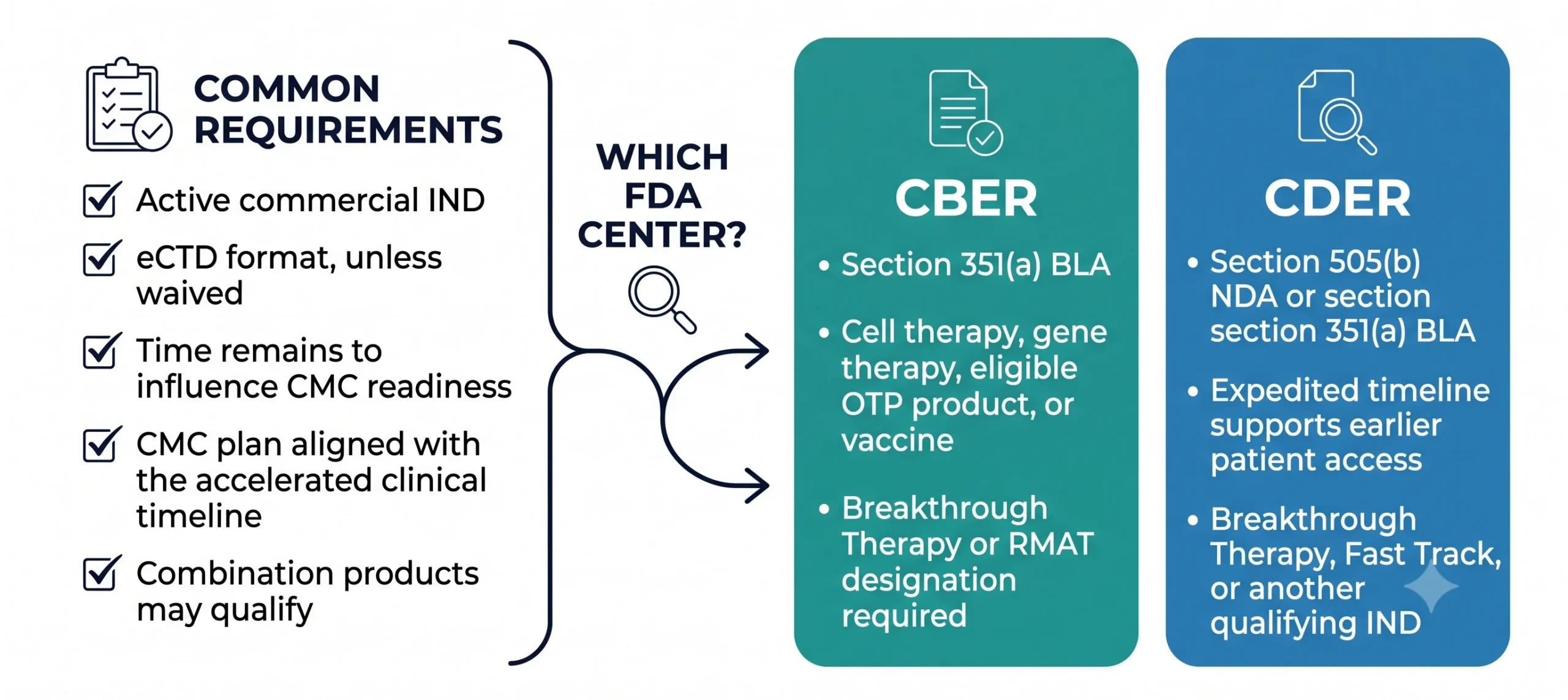
The Agency intends to select no more than nine proposals per fiscal year. Approximately two-thirds are expected to involve CBER-regulated products and one-third CDER-regulated products. Admission is therefore selective, even when a sponsor satisfies the stated eligibility conditions.

Fda Cber Cder Scaled

What should the Participation Request contain?

A sponsor should submit the request as an amendment to the IND. The cover letter should state: Request to Participate in the CMC Development and Readiness Pilot and identify a sponsor contact and list any expedited-program designations received by the product.

FDA expects the plan to address:

    • Product characterization and preliminary critical quality attributes.
    • Current drug substance and drug product processes, analytical methods, and control strategies, including methods still under development.
    • The proposed commercial manufacturing process and control strategy, including important differences from the clinical process.
    • Any necessary microbial control strategy.
    • Proposed commercial manufacturing facilities, including contract facilities, and plans for product availability at approval.
    • Drug substance and drug product stability programs and the proposed process-validation strategy.
    • Estimated timeframes for the remaining activities, anticipated CMC challenges and their potential effect on overall readiness.
    • The proposed month and year of the first CMC-specific Type B meeting under the pilot.

The request should not present a purely aspirational schedule. The plan should connect activities, dependencies, and risks to the anticipated clinical and marketing-application timelines. A list of incomplete activities without an integrated readiness strategy is unlikely to demonstrate how participation would affect the program.

Key dates:

  • October 1, 2026: FDA begins accepting year-five requests.
  • End of April 2027: FDA stops accepting new CDRP applications.
  • September 30, 2027: FY 2027 and PDUFA VII conclude.
  • After FY 2027: FDA will continue supporting previously accepted INDs until the marketing application is submitted or the IND is withdrawn.

How will FDA Select Participants?

FDA intends to acknowledge and review requests as they are received. The Agency intends to issue either a Proceed to Disclosure Agreement letter, if the product is selected, or a denial letter within 90 days of receiving the request.

Selection will consider:

  1. The anticipated clinical benefit of facilitating earlier patient access.
  2. The novelty of the investigational product.
  3. The complexity of the product, manufacturing process, or associated technology.
  4. The nature and significance of the anticipated CMC challenges.
  5. The overall balance and diversity of product types and therapeutic indications represented in the pilot.

A sponsor should therefore explain not only that its product is eligible, but also why enhanced FDA engagement could materially influence readiness and patient access. A strong request will define the CMC decisions that require FDA input and show how timely resolution could prevent development or submission delays.

CDRP in Practice: Publicly Disclosed Sponsor Experiences

At the September 10, 2025 FDA-supported public workshop, participating sponsors described how the CDRP had been applied to actual investigational products.

NTLA-2002: Earlier alignment on complex gene-editing CMC issues

Intellia Therapeutics discussed its CDRP experience with NTLA-2002, an investigational CRISPR-based gene-editing therapy for hereditary angioedema. Its CMC program involved several technically complex areas, including potency testing, comparability between clinical-development stages, lipid controls, guide-RNA impurities, process-performance qualification, and shelf-life assignment.

The sponsor reported that FDA’s preliminary feedback allowed it to proceed with significant validation activities with greater confidence in the proposed approach. This was sufficiently complete to cancel the first planned CDRP Type B meeting.

Key lesson: The case demonstrates the value of presenting specific, decision-ready questions before committing substantial resources to validation and pivotal-stage development. It also shows that useful engagement may occur through written or iterative feedback, rather than through formal meetings alone.

RYZ101: Addressing isotope supply and facility readiness

RayzeBio, a Bristol Myers Squibb company, discussed RYZ101, an investigational actinium-225 radiopharmaceutical. The product’s CMC challenges included limited isotope supply, possible use of actinium-225 manufactured through alternative production methods, associated impurity differences, manufacturing-facility readiness, and the limited availability of suitable contract manufacturers.

Through the CDRP, the sponsor discussed potential pathways for using actinium-225 from alternative sources and the evidence that could be required to address source-related impurities. Discussions also addressed the commissioning and regulatory readiness of a radiopharmaceutical manufacturing facility and communication with the appropriate FDA District Office.

Key lesson: The case illustrates that CMC readiness extends beyond process validation and specifications. For complex products, raw-material availability, source qualification, analytical controls, facility preparation, and supply continuity may all determine whether manufacturing can keep pace with clinical development.

FDA’s Lessons from the Pilot

Participation during the first three years was below the pilot’s capacity. CDER received 13 requests and accepted five, while CBER received eight requests and also accepted five. In total, 10 products were accepted against a possible three-year capacity of 27.

Sponsors cited uncertainty about eligibility, the resources required to participate, concerns about the disclosure agreement, and questions about the pilot’s added value to available expedited program benefits.

In response, FDA shortened its target decision period from 180 to 90 days, removed the two-year-before-submission expectation, de-emphasized sponsor inexperience, and simplified the requested CMC plan. Participating sponsors nevertheless reported that early planning and iterative feedback improved alignment and helped identify CMC barriers sooner.

Key takeaway: The CDRP is most useful when sponsors arrive with an integrated plan and focused, decision-ready questions.

What Happens Next?

The CDRP will run through fiscal year 2027, ending September 30, 2027. However, FDA will stop accepting new applications at the end of April 2027. FDA will continue supporting INDs already accepted into the pilot until the related marketing application is submitted or the IND is withdrawn.

FDA intends to incorporate lessons from the pilot into quality-assessment practices and other initiatives for products in expedited programs. CMC-focused Type B, C, or D meetings may also remain available where appropriate, including for products with Breakthrough Therapy, Fast Track, or RMAT designation.

The broader lesson is that CMC planning should begin early in accelerated development. The CDRP does not reduce product-quality standards or guarantee agreement with a proposed strategy. Its value lies in helping sponsors identify readiness risks, clarify FDA expectations, and align CMC activities with the clinical timeline before unresolved issues delay submission or patient access.

How can BLA Regulatory help?

Successful CDRP participation requires more than meeting the eligibility criteria. BLA Regulatory can help sponsors convert complex CMC issues into a clear regulatory strategy by identifying readiness gaps, aligning CMC and clinical timelines, preparing a credible participation request, and developing focused questions for FDA meetings. Our goal is to help sponsors obtain actionable feedback before unresolved CMC issues affect submission or launch readiness.

This newsletter is for informational purposes only and does not constitute formal legal or regulatory advice.

References

  1. Chemistry, Manufacturing, and Controls Development and Readiness Pilot (CDRP) Program. Program overview, objectives, application instructions, meeting information, and contact details.
  2. FDA’s Strategy Document on Facilitating Chemistry, Manufacturing, and Controls Readiness for Products with Accelerated Clinical Development. July 23, 2026. Pilot experience, lessons learned, regulatory-flexibility examples, and FDA’s action plan.
  3. Chemistry, Manufacturing, and Controls Development and Readiness Pilot Program; Program Announcement. Federal Register, September 2026, Document No. 2026-19277. Year five eligibility, application content, selection criteria, and participation procedures.
  4. Duke-Margolis Institute for Health Policy and FDA. Lessons Learned from the Chemistry, Manufacturing, and Controls Development and Readiness Pilot Program. Public workshop and presentation materials, September 10, 2025.