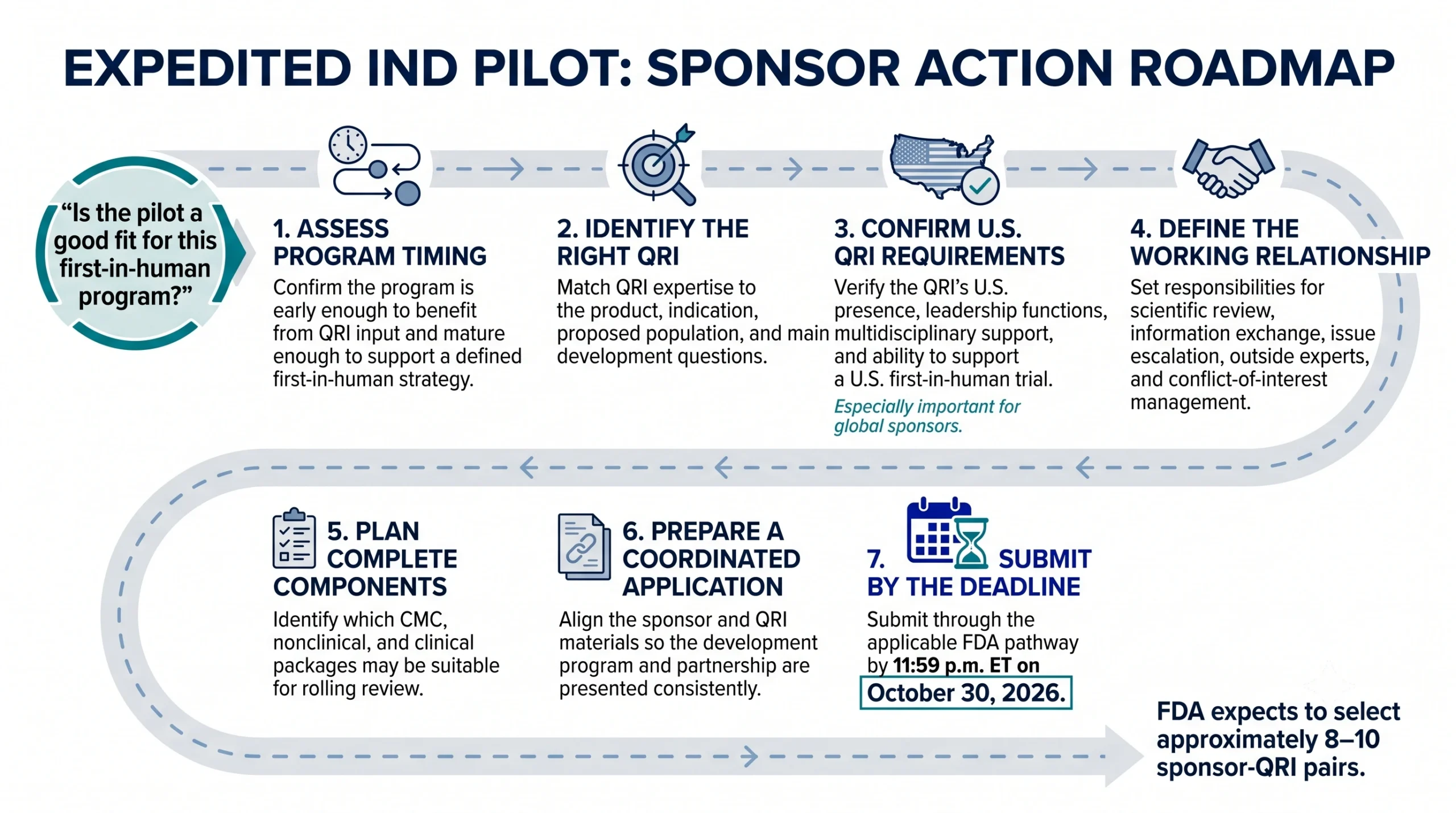
The Expedited Investigational New Drug Pilot has moved from proposal to implementation. On September 15, 2026, FDA announced the final design and began accepting applications from sponsors preparing first-in-human (FIH) clinical trials in the United States. Applications close at 11:59 p.m. ET on October 30, 2026, and FDA expects to select approximately eight to ten sponsor-QRI pairs for the initial cohort. [fda.gov], [fda.gov]
The pilot is an initiative under HHS Operation TrialBlazer designed to test new approaches for FIH clinical trials. Selected sponsors will work with qualified research institutions, or QRIs, and may submit discipline-specific components for FDA review during the pre-IND phase. The aim is to identify important issues earlier, improve submission quality, and make the path to first-in-human studies more predictable without changing FDA’s safety or scientific-review standards.
Why FDA Is Testing a New Model
During its August 2026 stakeholder webinar, FDA described several limitations in the existing early-development process. Sponsors must coordinate clinical, nonclinical, CMC, clinical pharmacology, and regulatory questions while deciding when their program is mature enough for a pre-IND meeting. A single formal interaction may not provide the continued multidisciplinary engagement needed as a complex development program evolves.
FDA also made an important distinction between moving faster and lowering standards. The agency’s stated objective is to identify avoidable delays while maintaining the scientific rigor and participant protections required for a first-in-human trial. In this context, “phase appropriate” means generating the information necessary to evaluate the proposed Phase 1 investigation, rather than completing later-stage work before it is needed.
The finalized pilot addresses these issues through two connected features: continuing scientific support from a QRI and rolling review of defined IND components. Together, these features are intended to create earlier alignment and reduce the likelihood that major issues remain unresolved when the final IND is submitted.
Is the Pilot Relevant to Your Program?
The pilot is designed for sponsors preparing for a first-in-human clinical trial in the United States. Participation is voluntary, and each sponsor may seek entry for a single planned IND with one designated QRI.
The program is not limited to one therapeutic area, product modality, or sponsor size. FDA intends to create a diverse cohort that includes different therapeutic areas, novel and established development approaches, product types, sponsor sizes, and QRI models. Applications will be assessed relative to one another, and no single factor will determine selection.
A program may be better positioned to benefit when it is early enough for the QRI and rolling-review process to influence development, but sufficiently defined to support a credible first-in-human strategy.
Sponsors that are not selected may continue to use established pathways, including INTERACT and pre-IND meetings. FDA has stated that non-selection will not disadvantage a sponsor or indicate that the development research is of lower quality.
What Global Sponsors Need to Know
The current materials do not expressly require the sponsor itself to be incorporated or headquartered in the United States. They do, however, establish specific U.S. organizational and operational conditions for the designated QRI.
The QRI must be organized or incorporated in the United States, maintain its principal place of business in the United States, and have U.S.-based core leadership functions in program management, regulatory affairs, and science. It must also be able to support the proposed U.S. first-in-human trial through its own infrastructure or documented partnerships.
This distinction is important for international developers. A global sponsor may continue using its existing CROs, consultants, laboratories, academic collaborators, and manufacturing partners, but an overseas organization should not be assumed to qualify as the designated QRI. The proposed QRI must independently meet the pilot’s U.S. criteria and provide or coordinate the expertise needed for the specific program.
Global sponsors must also be able to use the applicable CDER or CBER electronic submission pathway. The application requires an appropriate pre-submission tracking number and submission through the FDA Electronic Submissions Gateway.
Foreign sponsors should consider appointing a U.S. Agent to support direct communication with FDA, receive agency correspondence, and represent the sponsor in connection with the IND. For more information, see our PharmaFocus article, U.S. Agent for FDA Regulated Product Applications.
The QRI is not intended to function simply as a document processor. It is expected to serve as an accountable scientific partner that can provide integrated, risk-proportionate judgment across the disciplines supporting the first-in-human IND.
Relevant expertise may include nonclinical development, CMC, clinical development, clinical pharmacology, and regulatory affairs. The right capabilities will depend on the investigational product, therapeutic area, proposed population, and objectives of the first-in-human study. FDA stressed that QRI selection should be driven by the needs of the specific program rather than by a generic service model.
A QRI may use external subject-matter experts to address gaps in its internal capabilities. It remains responsible, however, for coordinating that support and determining whether each proposed component is ready for submission. Sponsors may continue to engage other CROs, CDMOs, laboratories, and consultants, but they may designate only one QRI for the pilot.
Before a component enters rolling review, the QRI is expected to assess whether it contains sound scientific rationale and supporting data. Its feedback should distinguish issues that must be resolved to avoid a clinical hold from opportunities that could further strengthen the package.
For sponsors, this means QRI selection should consider more than credentials or operational capacity. The QRI must be able to integrate evidence across disciplines, challenge the development strategy when necessary, and identify the questions that require FDA input.
QRI governance
The sponsor and QRI must establish an official business relationship outside FDA. QRIs must maintain written conflict-of-interest procedures, and where a QRI also operates the reviewing IRB, the pilot advisory role must remain separate from IRB membership and voting responsibilities.
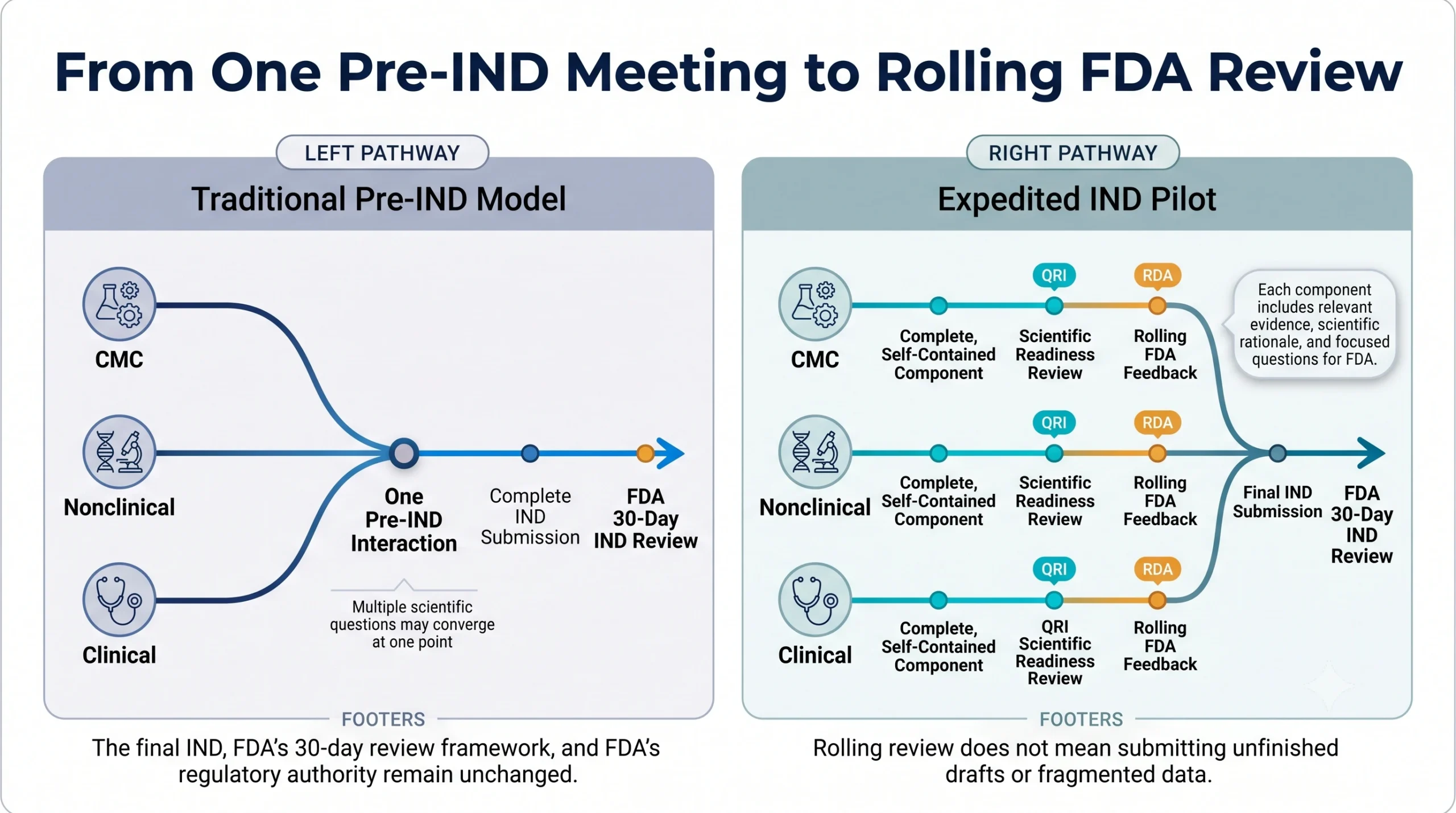
From One Pre-IND Meeting to a Rolling Review
The pilot replaces reliance on a single pre-IND interaction with rolling review of complete, discipline-specific components as they become ready.
Selected participants will receive further direction on what qualifies as a reviewable component and on expected timelines. The sponsor must still submit a formal IND, and outstanding material may be included directly in that application if rolling review would delay submission.
The Pilot Also Looks Beyond IND Submission
The latest FDA materials point to a broader practical issue: FDA authorization is not the only step required before a trial can begin. IRB review, site contracting, site activation, investigator readiness, and other operational activities may continue to delay first-patient enrollment.
The pilot encourages coordination of appropriate activities alongside IND preparation and review. FDA is testing whether sponsors, QRIs, IRBs, and clinical sites can reduce unnecessary sequential work while preserving each party’s responsibilities.
Sponsors should not interpret this as permission to assume that the IND will proceed. Parallel planning must remain appropriately controlled and consistent with regulatory, ethical, contractual, and organizational requirements.
The sponsor remains responsible for the completeness and accuracy of the IND. A QRI may serve as an authorized representative through Form FDA 1571, but that arrangement is optional and does not transfer the sponsor’s regulatory accountability.
The formal IND remains subject to the established 30-day review framework. FDA retains full authority to determine whether the clinical investigation may proceed and whether a full or partial clinical hold is warranted.
Accordingly:
-
- QRI endorsement is not FDA authorization.
- Rolling review does not replace the final IND.
- Pilot participation does not guarantee a shorter development timeline.
- The standards for scientific quality and participant protection remain unchanged.
The potential benefit lies in resolving important issues earlier and improving coordination, not in reducing the evidence needed to support a first-in-human study.