Bringing Japanese clinical sites into a global drug-development program starts with a specific regulatory requirement: Japan’s Clinical Trial Notification (CTN / 治験計画届) to the Pharmaceuticals and Medical Devices Agency (PMDA). Unlike a U.S. IND or an EU Clinical Trial Application, Japan’s CTN operates under distinct regulatory requirements, prescribed Japanese formatting, and filing timelines. Because an existing U.S. or EU submission package cannot be completely repurposed for PMDA, understanding the CTN pathway and its associated requirements early is essential to keeping global study timelines on track.
Japan CTN: How Can Global Sponsors Navigate PMDA Requirements?
November 19, 2026

Why Japan Belongs in the Global Clinical Trial Strategy
Including Japan in multiregional clinical trials (MRCTs) lets sponsors gather data for a major market alongside the U.S. and EU. A well-designed global trial can reduce the need for separate, delayed local studies.
For years, overseas sponsors could face delays in entering Japan because they often had to conduct a local Phase I trial before joining an MRCT. This was one factor contributing to drug lag and drug loss, where new medicines approved in the U.S. or Europe reached Japan later or did not enter development in Japan. A PMDA presentation reported that, as of March 2023, 86 drugs approved in the U.S. and Europe had not yet started development in Japan, with a relatively large proportion of emerging-biotech, orphan, and pediatric therapies.
To bring overseas programs into Japan earlier, MHLW December 2023 Phase I principles clarified that a separate Phase I study in Japanese participants is generally not required before joining an MRCT when the available evidence supports the clinical acceptability and manageability of the proposed dosing for Japanese participants. This assessment considers the available nonclinical and clinical data, potential ethnic differences, and the medical need for the drug. Where necessary, additional protocol safeguards, such as staggered initial dosing or closer early monitoring in Japanese cohorts, may also be incorporated into the MRCT design.
Still, skipping a local Phase I study does not skip the CTN. The applicable Japanese CTN filing and timing requirements remain in place, including the 30-day investigation period for specified initial notifications. The CTN remains a separate regulatory requirement for the proposed Japanese trial.
Which Trials Require a CTN?
Under Japan’s PMD Act, the CTN (治験計画届) is filed with PMDA for specified drug categories. These include new active ingredient drugs, new administration route drugs, new indication drugs, new dosage forms or doses, new medical combination drugs, similar prescription combination drugs, drugs expected to be classified as biological products, and drugs manufactured using recombinant technology. Certain bioequivalence studies are excluded. The sponsor must determine which category applies to the actual investigational product and protocol.
A CTN is a notification, not a marketing authorization. PMDA formally receives the filing and, for notifications subject to the 30-day investigation, may examine safety concerns. A complete administrative receipt does not mean that PMDA has approved the protocol. Site ethics review, Japanese GCP, contracts, and trial registration remain separate requirements (PMDA notification framework).
|
AT A GLANCE: CTN TIMING IS TIED TO THE TYPE OF FILING |
|
|
30 DAYS Specified first-in-Japan notifications, including new active ingredients, administration routes, and medical combination drugs, are subject to a statutory 30-day investigation before a sponsor can contract with a Japanese clinical trial site. |
ABOUT 2 WEEKS Other sponsor-initiated CTNs are generally submitted approximately two weeks before the planned site contract. This is a filing target rather than a statutory waiting period. The exact route and exceptions must be confirmed for the product. |
|
Exception Investigator-initiated studies have a different timing point, and their requirements should not be conflated with company-sponsored studies. Follow the applicable PMDA list of current notifications. |
|
Role of Japan’s In-Country Representative
Under Article 15 of the Japanese GCP Ordinance, a foreign sponsor without an address in Japan must appoint an eligible person residing in Japan to conduct clinical trial sponsorship procedures on its behalf. This person/entity is referred to as the Clinical Trial In-Country Representative (治験国内管理人), commonly referred to in the industry as the In-Country Clinical Caretaker (ICCC).
Key responsibilities include:
-
- Regulatory consultations: Actively participate in pre-trial PMDA regulatory consultations to help foreign sponsors define their clinical development strategy and ensure Japan-specific bridging or ethnic sensitivity requirements are met.
- Regulatory submissions: Submit the CTN to PMDA on behalf of the foreign sponsor, act as the local regulatory contact, and coordinate responses to regulatory queries and required notifications.
- Safety reporting: Report adverse events and other required safety information to Japanese regulatory authorities and clinical trial sites within applicable reporting timelines. The ICCC must also have appropriate arrangements with the foreign sponsor for receiving relevant global safety information.
- Regulatory compliance and documentation: Support compliance with Japanese GCP provisions, regulatory guidance and notification requirements, and inform the foreign sponsor of relevant regulatory changes, while maintaining designated clinical trial documentation.
The Japan CRO Association’s 2025 guidance on ICCC responsibilities provides further details on the allocation of these responsibilities.
The Actual Japan CTN Filing Process
1 | Determine the notification category and the filing pathway
Before preparing the notification, confirm that the investigational drug and proposed Japanese trial fall within CTN scope, identify the responsible filer, and check for any product-specific requirements or applicable exceptions. This classification determines the applicable filing procedures and timelines (PMDA filing rules and amendments).
2 | Assemble the Japanese filing
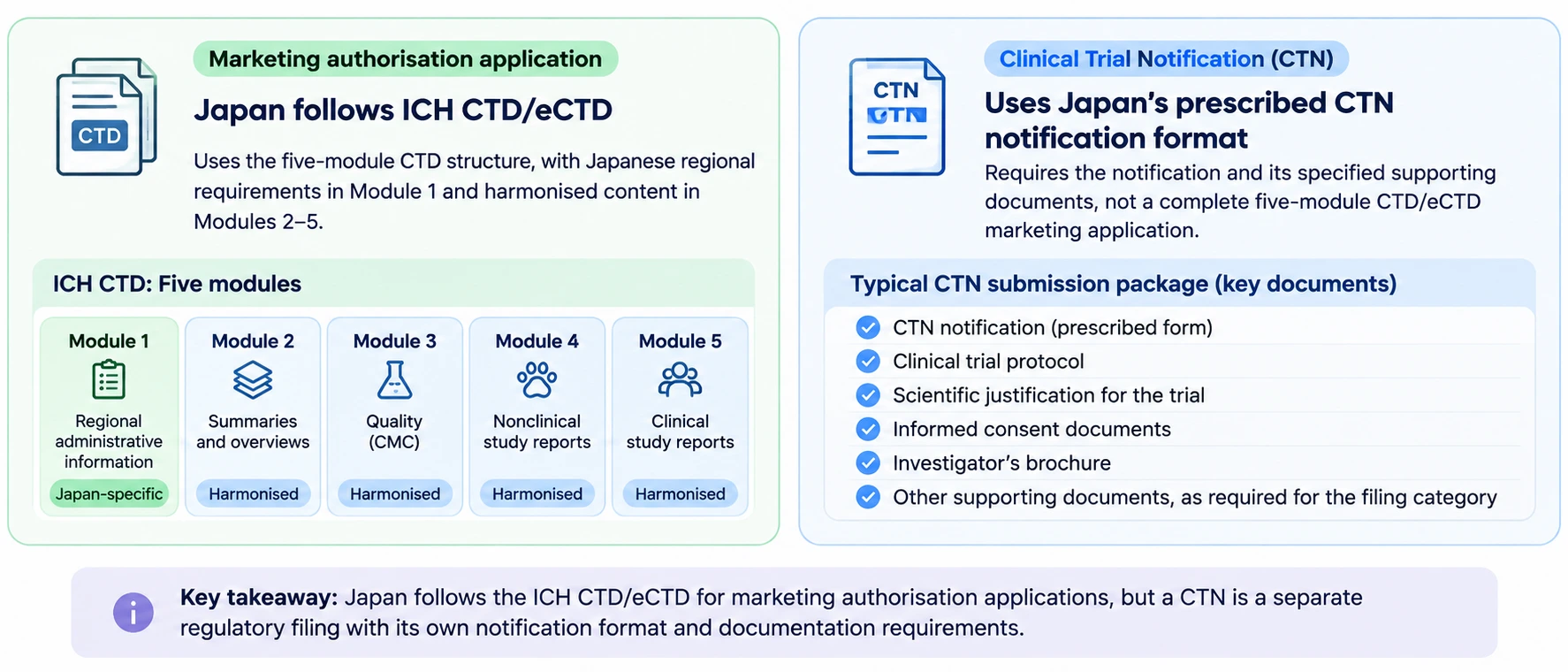
Once the applicable notification requirements have been established, sponsors must ensure that the supporting documentation is complete and appropriate for the specific filing. The CTN follows Japan’s prescribed forms and supporting-document requirements, different to the ICH eCTD. The exact attachments depend on the filing class, study and modality. Japan also has detailed identifiers, notice types, XML/file specifications and document naming rules. These requirements mean that existing U.S. IND or EU CTA materials may provide the scientific basis for the Japanese CTN filing but will need to be reviewed and adapted to meet PMDA’s applicable notification requirements (PMDA drug CTN notices and filing FAQ).
3 | File with PMDA and handle review questions
PMDA accepts CTN-related notices by post, appointment-based counter filing and, since January 2023, its online application electronic-data system (PMDA submission routes). Filing type, identifiers, documentary completeness and arrival or receipt date affect submission logistics. Submissions must follow the specified electronic file and document requirements. For postal submissions, sponsors should ensure that the filing reaches PMDA on the stated notification date. For notifications subject to the 30-day investigation, PMDA may raise questions or request additional information, and sponsors should be prepared to respond promptly to safety or quality queries.
4 | Meet local startup and ongoing requirements
CTN submission alone does not clear a site to enroll. Sponsors must also satisfy the Japanese GCP framework, institutional review board or other required ethics review, site contracting, and public trial-registration obligations, including jRCT as applicable. After the initial filing, PMDA provides distinct routes for clinical plan changes, trial completion, discontinuation and development termination. Most changes require notification before implementation, while specified administrative changes can follow different filing schedules (PMDA notice types).
ICH aligned, but not identical to U.S. or EU procedures
|
REGULATORY COMPARISON / SAME GLOBAL PROGRAM, THREE PATHWAYS |
||
|
JAPAN | CTN Notification to PMDA under Japanese rules. Specified first-in-Japan notifications trigger a 30-day investigation before a company-sponsored site contract; other CTNs generally have an approximately two-week filing lead time. |
UNITED STATES | IND Initial investigational new drug application to FDA. The IND generally becomes effective 30 days after FDA receipt unless placed on clinical hold or FDA authorizes an earlier start. |
EU | CTA/CTIS Clinical trial application submitted through CTIS under the EU Clinical Trials Regulation. Member States conduct a coordinated assessment, with each concerned Member State making its own authorization decision. |
How can BLA Regulatory help?
BLA Regulatory combines global drug-development expertise with an established presence in Japan to serve as an In-Country Clinical Caretaker (ICCC) for foreign sponsors conducting clinical trials in Japan.
We provide local regulatory representation and sponsor support, including CTN preparation and submission, PMDA interactions, regulatory strategy, safety reporting coordination, and oversight of Japan-specific regulatory requirements. Drawing on integrated CMC, nonclinical, clinical, and regulatory expertise, we help sponsors navigate Japanese regulatory requirements while maintaining alignment with their broader global development strategy. For companies entering Japan for the first time, our local presence and regulatory expertise provide a dedicated point of contact to facilitate regulatory compliance and a smoother path to clinical trial initiation.
Planning a clinical trial in Japan? Contact BLA Regulatory to discuss your ICCC requirements and CTN submission strategy.
Disclaimer: This article concerns investigational medicinal products; medical devices and regenerative medical products have separate pathways. Verify current Japanese-language notices and product-specific requirements before submission. Information checked October 19, 2026.