
From Foreign Phase 1 Studies to U.S. Phase 2: Getting EOP1 Meetings Right
June 18, 2026

For many global drug and biologic developers, the first human data package is no longer generated entirely in the United States. Sponsors may complete Phase 1 studies in Asia, Europe, Australia, or other regions, then seek US FDA agreement before moving into U.S. Phase 2 development, expansion cohorts, or a confirmatory strategy. This can be efficient, but only if FDA can understand and rely on the foreign data package.
An End-of-Phase 1 (EOP1) meeting is therefore not just a routine milestone. When foreign clinical data are central to the program, the EOP1 meeting should be used to align with FDA on the scientific bridge between what has already been learned outside the United States and what must be generated next for U.S. development. For products outside the categories where an EOP1 meeting is clearly appropriate, sponsors should first confirm whether an EOP1, Type C, Type D, or other formal meeting pathway is the right mechanism for discussing reliance on foreign Phase 1 data.
The goal is not to persuade FDA that foreign data are enough. The goal is to show, with evidence, that the data are reliable, ethically generated, inspectable, and relevant to the proposed U.S. population, dose, product, and development plan.
FDA Can Use Foreign Data, But the Burden Is on the Sponsor
FDA regulations and U.S. law do not prohibit reliance on foreign clinical data. The broader statutory principle is that, when determining whether to approve, license, or clear a medical product, FDA may accept clinical investigation data generated outside the United States if the applicant demonstrates that the data are adequate under applicable U.S. standards. The practical issue is whether FDA can rely on those data for the specific regulatory decision being requested.
For a foreign clinical study not conducted under a U.S. IND, 21 CFR 312.120 is the key regulation. FDA may accept a well-designed and well-conducted non-IND foreign study as support for an IND or marketing application if the study was conducted in accordance with Good Clinical Practice (GCP), including independent ethics committee review and informed consent, and if FDA can validate the data through onsite inspection when necessary.
If the foreign study was conducted under a U.S. IND, the issue is different. The sponsor must comply with applicable IND requirements regardless of where the clinical site is located, unless a requirement has been properly waived. This distinction should be clear in the meeting package. FDA should not have to infer whether a study was conducted under an IND, outside an IND, or as part of a mixed global program.
At the marketing application stage, 21 CFR 314.106 specifically addresses approval of a new drug application based solely on foreign clinical data. For biologics, sponsors should also consider the BLA framework under 21 CFR Part 601 and the broader statutory acceptance principle under 21 U.S.C. 360bbb-8b. This distinction matters because EOP1 discussions often occur well before the final NDA or BLA evidence package is fixed.
|
Foreign Data Question |
What FDA Will Usually Need to Understand |
|
Was the study conducted under a U.S. IND? |
If yes, FDA will expect compliance with applicable IND requirements. If no, the sponsor should map the study to 21 CFR 312.120. |
|
Can FDA rely on the data quality? |
The package should summarize GCP compliance, monitoring, audit history, data handling, protocol deviations, and inspection readiness. |
|
Are the subjects relevant to the U.S. population? |
The sponsor should compare demographic, intrinsic, and extrinsic factors with the intended U.S. patient population. |
|
Is the product comparable? |
The drug substance, drug product, formulation, specifications, potency, and manufacturing site history should be linked to the product proposed for U.S. studies. |
|
Does the foreign study answer the right U.S. question? |
Endpoints, comparators, dose, standard of care, concomitant therapies, and safety monitoring must be relevant to the proposed U.S. development plan. |
What an Effective EOP1 Meeting Should Accomplish
An EOP1 meeting should convert foreign Phase 1 experience into a clear U.S. development path. For products regulated by FDA’s Office of Therapeutic Products (OTP), FDA describes the purpose of an EOP1 meeting as discussion of product development plans for Phase 2 or design of confirmatory trials. For CDER or non-OTP programs, sponsors should apply the same strategic logic but confirm that the selected meeting type fits the review division’s expectations and the maturity of the data package. The meeting should focus on whether the sponsor has enough clinical, nonclinical, CMC, and statistical support to take the next development step.
For programs using foreign data, the strongest EOP1 packages usually ask FDA to confirm or comment on discrete regulatory conclusions rather than broad statements. For example, a weak question is: “Does FDA accept our foreign Phase 1 data?” A stronger question is: “Does FDA agree that the completed non-IND Phase 1 study, supported by the 21 CFR 312.120 compliance summary in Module X, is adequate to support the proposed Phase 2 starting dose and safety monitoring plan in U.S. patients?”
This framing matters because FDA reviewers respond best to traceable questions. Each question should connect to a decision the sponsor must make: dose selection, population enrichment, bridging pharmacokinetics, inclusion of U.S. sites, safety monitoring, CMC comparability, or the need for additional nonclinical work.
Key Questions to Resolve at EOP1
- Does FDA agree that the foreign Phase 1 safety database is sufficient to support the proposed Phase 2 dose range and escalation approach?
- Does FDA agree that the pharmacokinetic and pharmacodynamic data are interpretable for the U.S. population, or is a U.S. bridging cohort needed?
- Are there ethnic factors, medical practice, diet, body weight, concomitant medication, genetic, or disease-stage differences that could affect applicability?
- Does FDA agree with the proposed plan to address product comparability between the foreign clinical batch and the U.S. clinical batch?
- Is the sponsor’s 21 CFR 312.120 documentation sufficient, or should additional site-level records, IEC documentation, informed consent records, or monitoring records be submitted?
- Does FDA agree that the proposed Phase 2 endpoints, safety monitoring, and stopping rules adequately address risks identified in the foreign study?
Building the Meeting Package Around the Foreign Data Bridge
The meeting package should be organized around FDA review logic. Sponsors often fail by submitting a large foreign clinical study report and assuming that the conclusion will be obvious. A better approach is to build a foreign data bridge: a short, disciplined argument that explains why each foreign data element can support the U.S. decision being requested.
|
Package Component |
Recommended Content |
|
Foreign data map |
List each completed foreign study, country, site count, IND status, phase, objectives, dose levels, population, and role in the U.S. development plan. |
|
GCP and ethics summary |
Summarize IEC approval, informed consent, monitoring, audit findings, protocol deviations, data corrections, and records available for inspection. |
|
Population applicability analysis |
Compare age, sex, race/ethnicity where available, disease stage, prior therapy, body weight, organ function, biomarkers, and standard of care to the intended U.S. population. |
|
Clinical pharmacology bridge |
Explain dose proportionality, exposure-response, PK/PD, food effects if relevant, immunogenicity if applicable, and whether intrinsic/extrinsic factors could alter exposure. |
|
CMC comparability bridge |
Describe drug substance, drug product, batch release, formulation, specifications, manufacturing site, analytical methods, and changes before the U.S. study. |
|
Data governance and access |
Identify where source records, electronic systems, audit trails, lab data, imaging, and case records are maintained and whether FDA inspection access is feasible. |
|
Phase 2 proposal |
Present the proposed U.S. protocol synopsis, starting dose rationale, escalation rules, sentinel/staggered dosing if relevant, safety monitoring, and stopping rules. |
2025-2026 Policy Signals: Foreign Data Are Not Rejected, But Scrutiny Is Rising
Recent policy signals should not be misread as a general FDA rejection of foreign clinical data. The better interpretation is that FDA and U.S. policymakers are paying closer attention to data provenance, foreign operational control, biological sample movement, cybersecurity, and the ability of FDA to verify the evidence used in regulatory decision-making.
FDA’s June 2025 announcement on clinical trials involving transfer of U.S. patients’ living cells to certain foreign laboratories was directed at a specific cross-border cell-processing and genetic-engineering risk. Separately, congressional attention in March 2026 raised concerns about foreign involvement in U.S. clinical trials and drug approvals. You can read our breakdown regarding this here – Latest News: Proposed US FDA Scrutiny on Cross-Border Clinical Data!
These developments do not rewrite 21 CFR 312.120, 21 CFR 314.106, or ICH E5. They do, however, make early FDA engagement more important for programs involving foreign sites, foreign manufacturing, foreign data systems, or sensitive biological materials.
For EOP1 strategy, sponsors should treat this as a documentation and transparency issue. If foreign data are important to the U.S. development plan, the sponsor should be prepared to explain not only the clinical result, but also who generated the data, where the source records are held, whether FDA can inspect the site or data system, how subject consent addressed biological samples and data transfer, and whether any foreign vendor or manufacturing arrangement creates additional risk.
The Sponsor’s Checklist
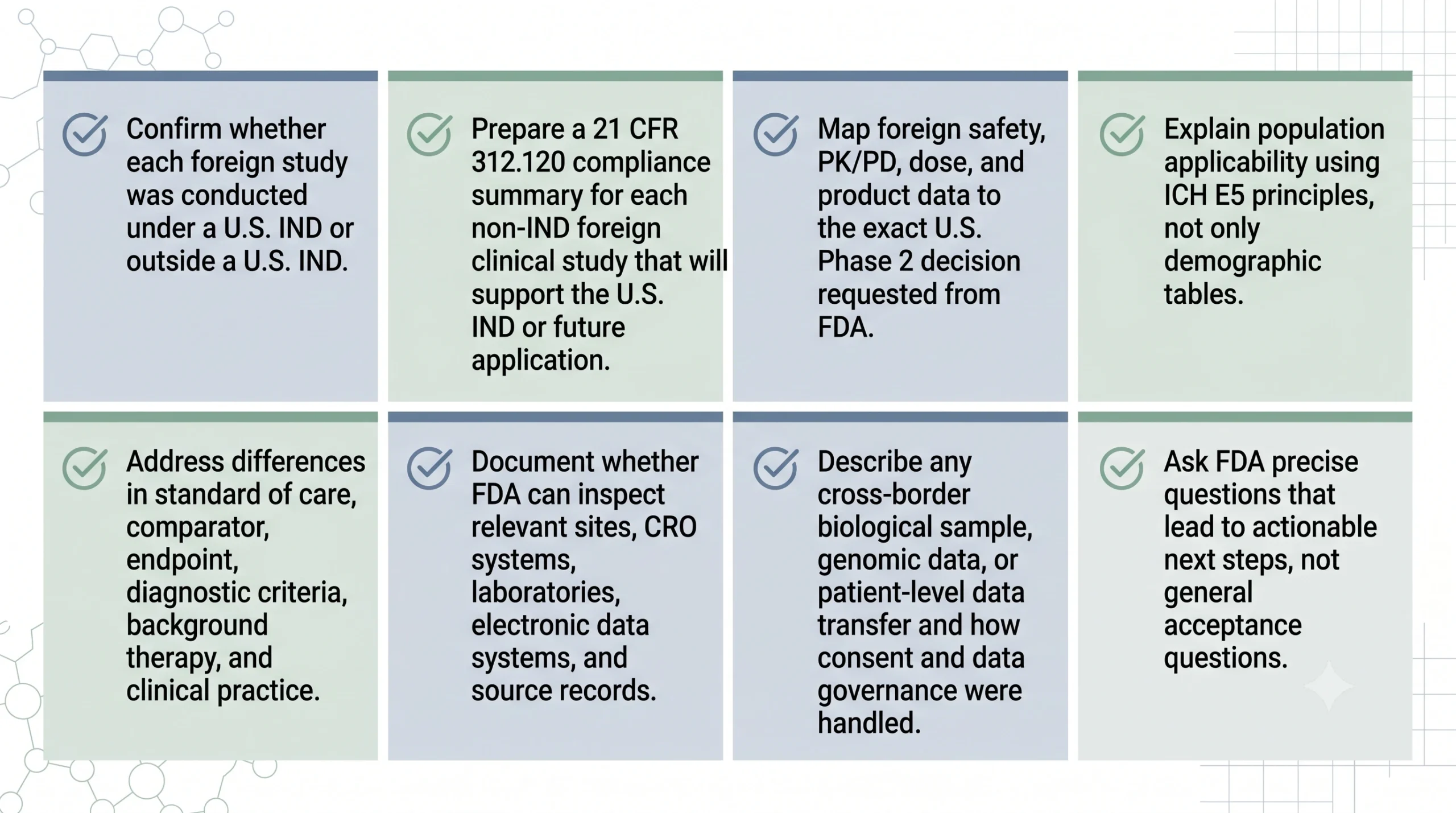
Common Pitfalls That Weaken an EOP1 Foreign Data Strategy
The most common weakness is treating foreign data acceptability as a legal checkbox. Compliance with 21 CFR 312.120 is necessary, but not always sufficient. FDA still evaluates whether the study design, population, product, and endpoint answer the U.S. regulatory question.
A second weakness is ignoring product comparability. This is particularly important for biologics, cell therapies, gene therapies, complex injectables, and products where manufacturing changes occur between the foreign Phase 1 study and the proposed U.S. Phase 2 study. Clinical data generated with one product version may not fully support another version unless the sponsor explains the analytical and manufacturing bridge.
A third weakness is asking FDA to agree to too much at once. An EOP1 meeting is most effective when the sponsor separates the discussion into manageable review disciplines: clinical safety, clinical pharmacology, statistics, nonclinical, CMC, and data integrity. This allows FDA to give targeted feedback and reduces the risk of ambiguous meeting minutes.
Final Perspective
Foreign Phase 1 data can be a valuable regulatory asset. It can accelerate U.S. development, reduce unnecessary duplication, and support faster decisions when the data are scientifically relevant and operationally verifiable. But foreign data becomes risky when the sponsor cannot explain how they were generated, how they apply to U.S. patients, or how FDA can validate them.
The EOP1 meeting is the right place to solve that problem early. Sponsors should use the meeting to build agreement on the data bridge before committing major resources to U.S. Phase 2 or confirmatory development. In the current environment, the best strategy is not defensiveness. The best strategy is transparency, discipline, and a well-supported regulatory narrative.
How BLA Regulatory Can Help
BLA Regulatory helps sponsors transform foreign clinical experience into a defensible U.S. regulatory strategy. For EOP1 meetings involving foreign data, our support is focused on the specific issues FDA reviewers are likely to test: data reliability, GCP documentation, U.S. applicability, product comparability, Phase 2 readiness, and the clarity of FDA meeting questions.
-
- EOP1 meeting strategy and meeting request preparation
- Foreign clinical data gap assessment under 21 CFR 312.120
- FDA meeting package authoring and discipline-specific question design
- Clinical pharmacology and population applicability bridge planning
- CMC comparability strategy for foreign-to-U.S. clinical transition
- Inspection-readiness review for foreign sites, CROs, laboratories, and data systems
- IND amendments and U.S. Phase 2 protocol alignment after FDA feedback
Our goal is to help sponsors enter FDA meetings with a clear position, a complete evidence map, and questions that generate usable FDA feedback. For foreign data programs, that preparation can be the difference between a smooth U.S. transition and a costly request for additional bridging work.
References
- FDA. Formal Meetings Between the FDA and Sponsors or Applicants of PDUFA Products. Draft Guidance. September 2023.
- FDA. OTP IND End of Phase Meetings.
- 21 CFR 312.47 – Meetings.
- 21 CFR 312.120 – Foreign Clinical Studies Not Conducted Under an IND.
- FDA. FDA Acceptance of Foreign Clinical Studies Not Conducted Under an IND: Frequently Asked Questions.
- 21 CFR 314.106 – Foreign Data.
- ICH E5. Ethnic Factors in the Acceptability of Foreign Clinical Data.
- FDA. E6(R3) Good Clinical Practice. Final Guidance. September 2025.
- 21 U.S.C. 360bbb-8b – Use of Clinical Investigation Data from Outside the United States.
- FDA. FDA Halts New Clinical Trials That Export Americans’ Cells to Foreign Labs in Hostile Countries for Genetic Engineering. June 18, 2025.
- U.S. Senator Rick Scott. Review of CCP Involvement in U.S. Clinical Trials and Drug Approvals. March 19, 2026.
- BLA Regulatory. Proposed US-FDA Scrutiny on Cross-Border Clinical Data. May 7, 2026.
- BLA Regulatory. U.S. FDA Tightens Oversight of Cross-border Cell Exports. April 23, 2026.
This newsletter is for informational purposes only and does not constitute formal legal or regulatory advice.