FDA Platform Technology: What Sponsors Need to Know Now
May 21, 2026
FDA continues to modernize how it reviews drugs and biologics, especially when sponsors use repeatable technologies across multiple products. One recent development is the Platform Technology Designation Program, introduced in a draft guidance issued in May 2024.
The program creates a formal pathway for FDA to evaluate a shared technology and then rely on this knowledge for products that will use the same platform in the future. For small and mid-size sponsors, this approach has the potential to reduce duplication, improve planning, and support more efficient development.
As of today, the guidance remains draft and non-binding. FDA still evaluates each application independently, and designation is not automatic. Early designations, including one revoked within a month, show that the framework is already being tested in real regulatory settings. Sponsors must clearly explain why the platform is well understood and how it creates real efficiency.
Understanding FDA’s Platform Technology Designation Program
What Qualifies as a Platform Technology?
To be eligible, a product must incorporate or use a platform technology that meets all criteria:
-
- Well‑understood and reproducible
- Incorporated into an FDA‑approved NDA or BLA
- Adaptable for use across multiple products with shared structural elements
- Facilitate standardized manufacturing or development for multiple products.
- Early evidence must show it can be used in more than one drug without adverse effects on quality, manufacturing, or safety.
Capable of delivering meaningful efficiency in development, manufacturing, or review
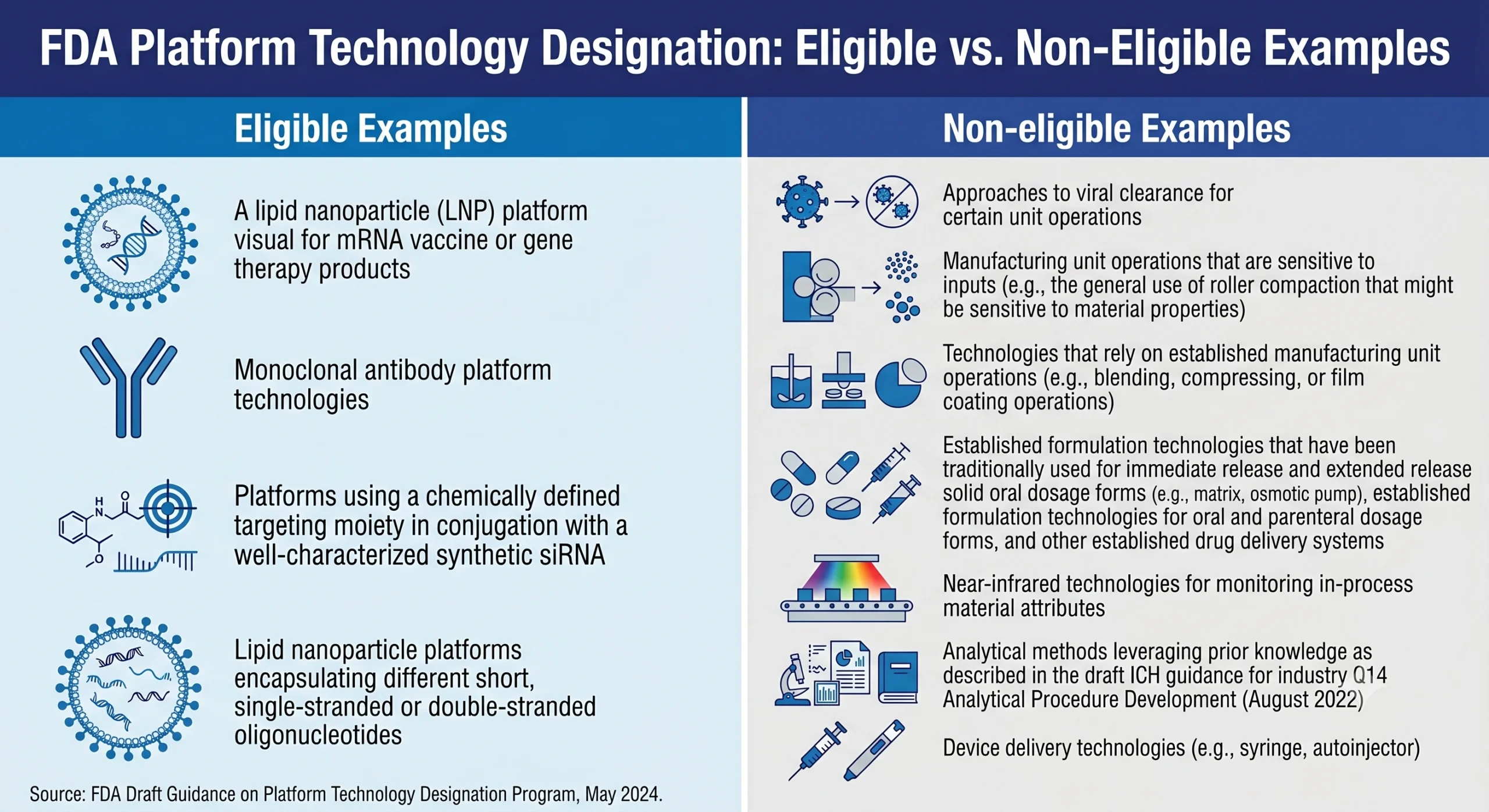
FDA is explicit that not all industry‑labeled platforms qualify. Technologies that cannot support cross‑product comparability or efficiency will be rejected.
What the Designation Does, and Does Not Do
-
- Platform designation does not waive regulatory requirements. Each IND, NDA, or BLA must still demonstrate safety, quality, and effectiveness for the specific product under review.
- The platform does not automatically grant priority review or expedited approval.
- The designation allows FDA to rely on prior knowledge when the sponsor shows that the same platform performs consistently across products. In practice, this may reduce duplication of data and analysis of certain manufacturing, analytical, or nonclinical information.
- Only the original sponsor or those with full rights of reference can leverage the designation. Third parties need a business arrangement for rights of reference.
- FDA may revoke a designation if later data show that the platform no longer behaves consistently.
Core Eligibility Requirements
Requirement |
FDA Expectation |
Approved Product |
Platform must be used in an FDA‑approved NDA or BLA |
Preliminary Evidence |
Data showing use across multiple products without negative impact |
Quality & Safety |
No new risks introduced by platform reuse |
Efficiency |
Clear reduction in development or review burden |
2025 – 2026: Early Signals from FDA’s Platform Technology Program
While the program guidelines remain in draft form, FDA has already begun applying the framework in real regulatory decisions.
🧬 June 2025 – First-Ever Designation
In June 2025, FDA granted its first platform technology designation to Sarepta Therapeutics for its AAVrh74 viral-vector gene therapy platform. This marked a significant milestone, signaling the FDA’s willingness to formally recognize repeatable technologies across programs.
⚠️ July‑2025 – Designation Revoked
A month later, the FDA revoked the designation, citing the three patient deaths linked to Sarepta’s platform. This action underscores that designation is not fixed and may be reconsidered as new data emerge.
🧪 October 2025 – Second Designation
FDA issued a second designation in October 2025 to Krystal Biotech for its non-replicating HSV‑1 viral-vector gene delivery platform. Unlike the first case, this designation has remained in place, suggesting a more cautious but continuing application of the program.
Sponsors should view platform designation not as a one‑time milestone, but as a lifecycle commitment requiring sustained comparability, data generation, and risk management across products. Safety signals in one product can affect the entire platform.
What Sponsors Can Gain
When the designation is well supported, sponsors may benefit from:
-
- Earlier and more focused FDA discussions on the platform itself
- Leveraging prior stability, batch, analytical, and inspectional data
- More efficient CMC strategies for follow‑on INDs and BLAs
- Better alignment across development programs
Importantly, FDA has clarified that prior data may still be leveraged without formal designation when scientifically justified. The designation formalizes and operationalizes that reliance.
What FDA Expects in a Designation Request
A strong request typically includes:
-
- A clear description of the technology and statutory fit
- Identification of approved reference products
- Cross‑product comparability analysis
- Justification for data reuse across applications
- Risk assessment with defined mitigation strategies
Weak submissions often fail due to vague scientific rationale or unsupported efficiency claims.
Once FDA receives a complete designation request, the Agency intends to complete its review within approximately 90 days. During this period, FDA may request clarification or additional information if questions arise. Sponsors should account for this review window when planning development timelines and FDA interactions.
When to Engage FDA
FDA encourages early discussion during:
-
- Pre‑IND meetings
- Type B or Type C milestone meetings
- Before pivotal study initiation
- Before finalizing CMC scale‑up or comparability plans
Early engagement reduces rework and misalignment later in development.
Final Perspective
FDA’s Platform Technology Designation Program represents a meaningful shift toward lifecycle‑based review. However, it does not replace regulatory strategy.
AI tools can assist with data analysis and document preparation. They cannot replace scientific judgment, regulatory interpretation, or FDA negotiation. The value of the program depends on how well sponsors integrate platform science into a coherent regulatory narrative.
How BLA Regulatory Can Help
BLA Regulatory helps sponsors turn platform concepts into defensible regulatory assets:
-
- Platform Eligibility Assessment
- Comparability and Preliminary Evidence Strategy
- CMC, Nonclinical, and Clinical Alignment
- FDA Meeting Preparation and Briefing Packages
- Designation Request Authoring and Submission
- Long‑Term Platform Lifecycle Strategy
Our goal is not just to secure a designation, but to help sponsors use platform strategies to support long-term pipeline development in the U.S.
References
- Platform Technology Designation Program for Drug Development (Draft Guidance). March 2026
- Formal Meetings Between the FDA and Sponsors or Applicants of PDUFA Products (Draft Guidance). 2023.
- NIH Clinical Center. FDA Responses and Meetings for Investigational New Drug Applications.
- 21 CFR 312.82 – Early Consultation
- NIH SEED Office. Regulatory Interactions: CBER–CDER Pre‑IND Meetings.
This newsletter is for informational purposes only and does not constitute formal legal or regulatory advice.