Gain First-to-Market Advantage: US FDA Priority Review Voucher Programs
July 30, 2026

Global biopharmaceutical sponsors must continually optimize their regulatory strategies to accelerate time-to-market and secure competitive advantages. The U.S. FDA utilizes Expedited Review Programs to incentivize innovation in areas of profound unmet medical need. While traditional statutory Priority Review Vouchers (PRVs) have successfully served as transferable, non-dilutive funding vehicles for over a decade, the FDA radically altered the landscape with the June 2025 launch of the Commissioner’s National Priority Voucher (CNPV) pilot program.
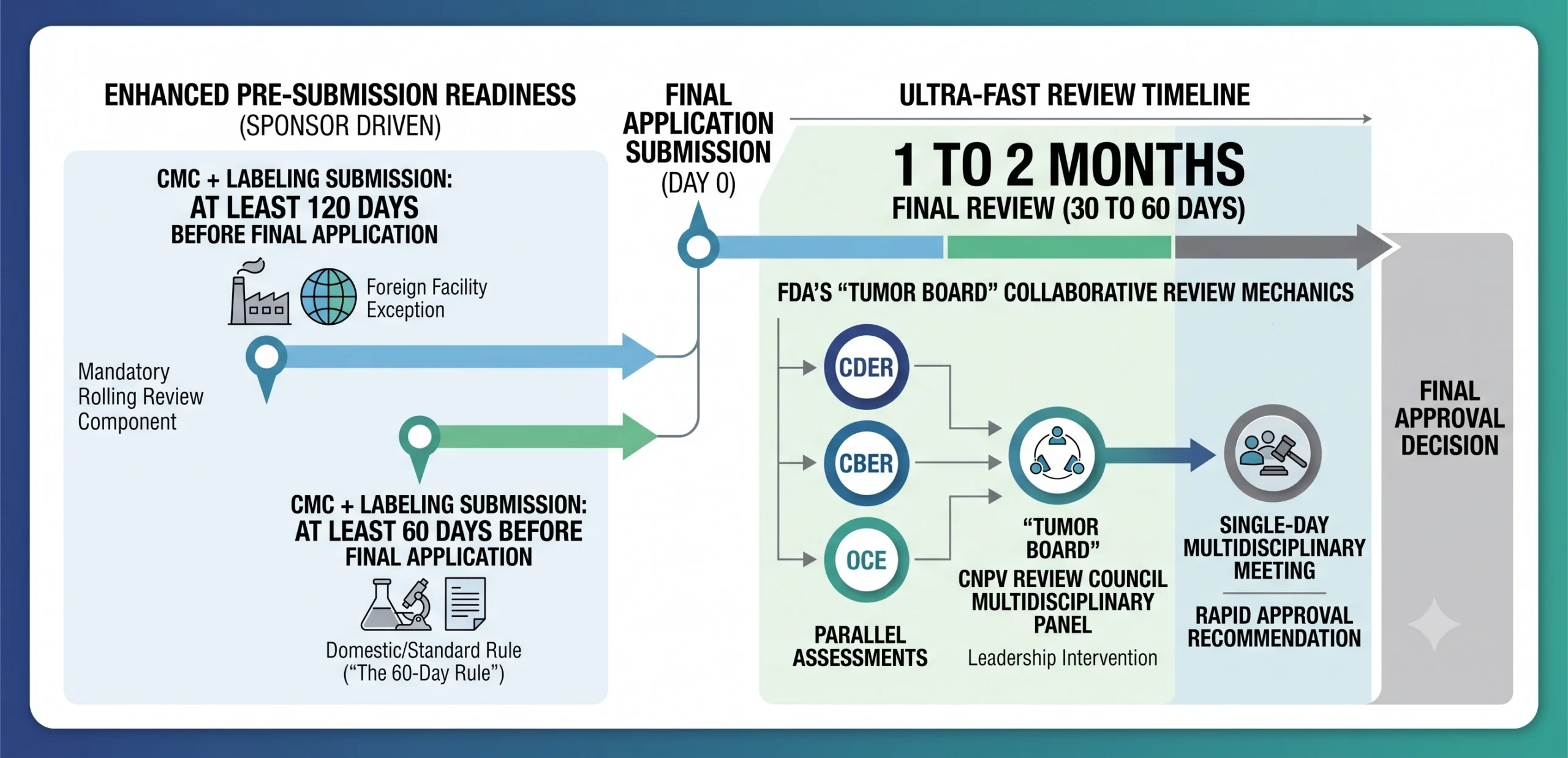
For global clinical operations and regulatory teams, understanding the strict procedural differences between standard statutory PRVs (compressing review times from 10 to 6 months) and the novel CNPV (compressing reviews to 1 to 2 months) is critical. This edition of PharmaFocus deconstructs the operational nuances, eligibility criteria, and market dynamics of all four programs, providing actionable intelligence for global sponsors.
Rare Pediatric Disease (RPD) PRV Program
Implemented in July 2012, under Section 529 of the FD&C Act.
- Target Population: The disease must primarily affect individuals aged 18 years or younger.
- Prevalence: The disease must affect fewer than 200,000 persons in the U.S. or lack a reasonable expectation that domestic sales will recover development costs.
- Designation Requirement: Sponsors must obtain an RPD Designation from the FDA before submitting the New Drug Application (NDA) or Biologics License Application (BLA).
- Legislative Status: Following temporary sunset phases, the enacted Mikaela Naylon Give Kids a Chance Act officially extended the FDA’s authority to issue RPD PRVs through September 30, 2029, providing long-term predictability.
- Voucher Volume:Early Government Accountability Office (GAO) 2020 data showed 19 RPD PRVs awarded within their first decade, with volume scaling significantly in recent years. Historically, the RPD program has generated the highest number of vouchers among statutory PRV programs.
- FDA Guidance: Rare Pediatric Disease Priority Review Vouchers, July 2019.
Tropical Disease (TD) PRV Program
Implemented in September 2007, under Section 524 of the FD&C Act.
- Target Indications: Infectious diseases prevalent in developing nations. The FDA maintains a specific list of qualifying pathogens. The current statutory and FDA-designated list includes:
- Malaria, Tuberculosis, Ebola virus disease, Zika virus disease, Lassa fever, Rabies, Cryptococcal meningitis, Blinding trachoma, Buruli Ulcer, Cholera, Dengue/Dengue haemorrhagic fever, Dracunculiasis (guinea-worm disease), Fascioliasis, Human African trypanosomiasis, Leishmaniasis, Leprosy, Lymphatic filariasis, Onchocerciasis, Schistosomiasis, Soil-transmitted helminthiasis, Yaws, Chagas disease, Neurocysticercosis, Marburg virus disease, Nipah virus infection, and Chikungunya virus disease.
- Novelty Requirement: The application must be for a novel drug containing no active ingredient previously approved by the FDA.
- Legislative Status: Unlike the RPD program, the TD PRV authority does not currently have a statutory sunset date, offering permanent programmatic stability.
- Voucher Volume: Lower utilization than the pediatric pathway, with approximately 10 TD PRVs awarded during the program’s first 13 years (per 2020 GAO data).
- FDA Guidance: Tropical Disease Priority Review Vouchers, Oct 2016.
Material Threat Medical Countermeasure (MCM) PRV Program
Implemented in December 2016, under Section 565A of the FD&C Act.
- Target Indications: Drugs and vaccines developed to prevent or treat harm from biological, chemical, radiological, or nuclear (CBRN) threats.
- Military/Defense Alignment: Highly specialized pathway utilized by sponsors collaborating with defense agencies like BARDA.
- Legislative Status (Sunset): Statutory authority for this program officially ended on October 1, 2023. No new vouchers are being issued, though previously awarded vouchers remain valid to use.
- Voucher Volume: The lowest utilization, with only 2 MCM PRVs granted by the 2020 GAO evaluation.
- FDA Guidance: Material Threat Medical Countermeasure Priority Review Vouchers, Jan 2018.
Mechanics of Statutory PRVs Redemption and Market Dynamics
Regardless of whether a sponsor qualifies under the RPD, TD, or MCM PRV pathway, the operational, financial, and procedural rules governing the vouchers are identical.
Award Timing & Redemption Process
- When it is received: Vouchers are issued after NDA/BLA approval of the qualifying rare pediatric or tropical disease drug. The FDA issues the PRV concurrently with the approval letter.
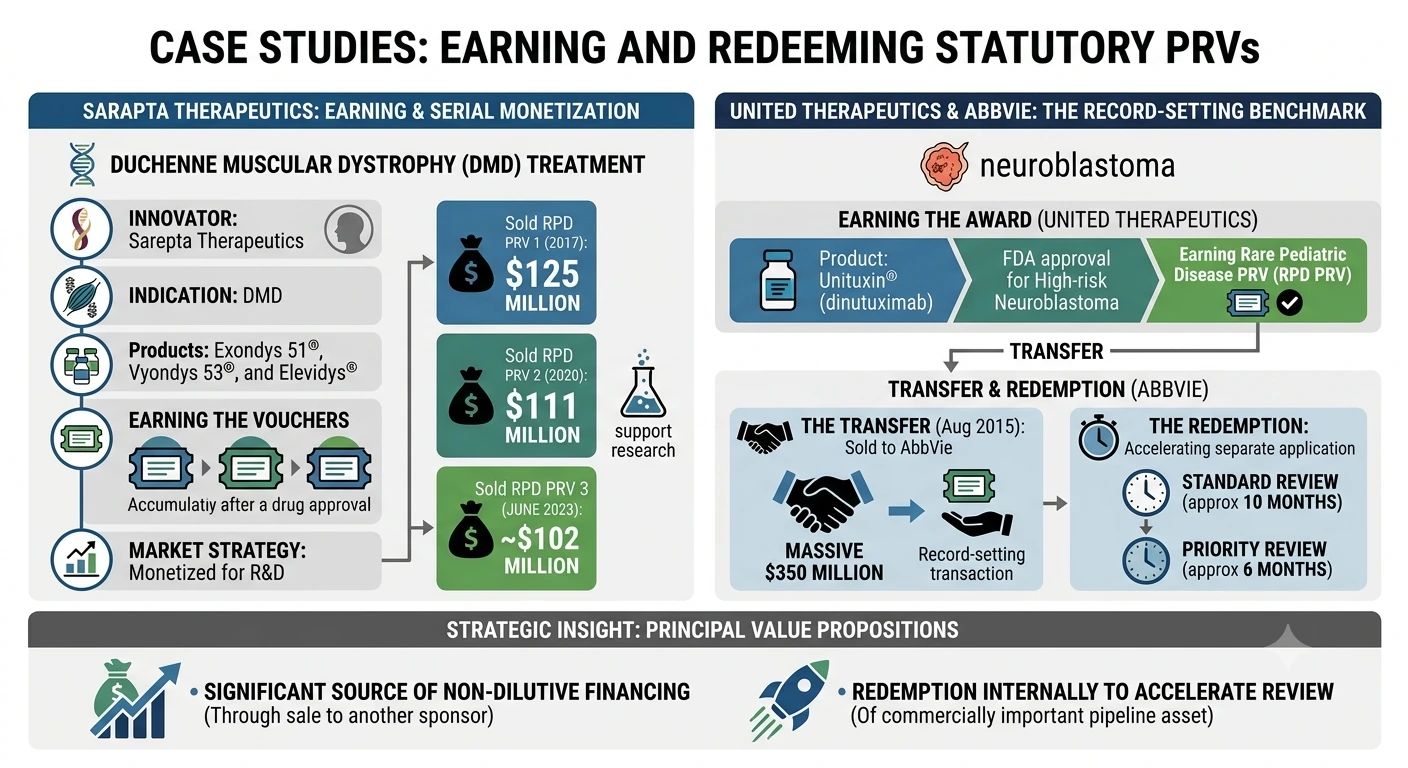
- What happens next: Once the sponsor has the voucher in hand, they can sell it on the open market or hold onto it. When they (or the company that bought it) are ready to submit a future, completely different NDA/BLA, they redeem the voucher alongside that new submission to compress its review timeline.
- Standard vs. Priority: Redeeming the voucher reduces a standard 10-month FDA review timeline to a 6-month priority review.
- 90-Day Intent Notification: A sponsor must legally notify the FDA of their intent to redeem a voucher at least 90 days before the actual submission of the drug marketing application.
PRV User Fees
- Universal Rate: The FDA publishes a unified Priority Review Voucher User Fee rate annually in the Federal Register. It is identical across all three programs. This fee must be paid in addition to standard Prescription Drug User Fee Act (PDUFA) application fees.
|
Fee Category |
FY 2026 Fee |
Description |
|
Priority Review Voucher (PRV) User Fee |
$1,962,472 |
The supplemental fee required to redeem a PRV and compress the review timeline to 6 months. |
|
Standard PDUFA Fee (Requiring Clinical Data) |
$4,682,003 |
The baseline application fee required by the FDA to review an NDA/BLA that includes clinical data. |
|
Standard PDUFA Fee (Not Requiring Clinical Data) |
$2,341,002 |
The baseline application fee required by the FDA to review an application without covered clinical data. |
- No Waivers: The FDA does not grant waivers, exemptions, or reductions for the PRV redemption user fee.
Transferability and Secondary Market Valuations
Statutory PRVs act as a vital non-dilutive financing tool for emerging biotech firms.
- Unlimited Transfers: Vouchers can be legally transferred (sold) an unlimited number of times before redemption, provided the FDA is notified of the transfer.
- Stabilized Valuations: While early scarcity drove peak prices up to $350 million (g., AbbVie’s 2015 purchase), increased voucher volume has stabilized the market. Based on recent SEC disclosures and GAO tracking (GAO-20-251), the current average secondary-market sale price ranges from $80 million to $130 million.
Commissioner’s National Priority Voucher (CNPV) Pilot Program
Launched on June 17, 2025, the Commissioner’s National Priority Voucher (CNPV) pilot program represents the most aggressive regulatory timeline in modern drug development. It directly aligns drug approval with U.S. national health and security priorities.
Objectives and Eligibility
- Strict Criteria: The FDA issues a strictly limited number of these vouchers annually to companies addressing urgent public health mandates. Eligibility is centered around five core national priorities:
-
- Public health crisis response,
- Innovative breakthrough therapies,
- Large unmet medical needs,
- Onshoring and supply-chain resilience, and
- Approaches that improve affordability, value, or patient access.
- Award Timing (The Access Pass): Unlike statutory PRVs, CNPVs are awarded before final approval to accelerate a specific pipeline drug.
- Pilot Success: As of May 8, 2026, FDA reported 7 approvals completed under the CNPV pilot program. Separately, FDA reported that 18 products had received CNPV awards by December 19, 2025.
- FDA Guidance: FAQs: Commissioner’s National Priority Voucher Pilot Program
Ultra-Fast Review Timelines and Collaborative Process
Non-transferability and Strategic Restrictions
- Strictly Nontransferable: The CNPV cannot be sold on the open market. It is tied to the original sponsor (though it remains valid if the company is acquired).
- Expiration: CNPVs must be redeemed within two years of issuance to ensure the pilot addresses immediate national crises.
Strategic Comparison for Global Sponsors
|
Feature |
Statutory PRVs (RPD, TD, MCM) |
Commissioner’s CNPV Pilot |
|
Review Target |
6 Months (Priority Review) |
1 to 2 Months (Ultra-Fast) |
|
Award Timing |
Issued after drug approval |
Issued before final approval |
|
Transferability |
Yes (current MV $80M – $130M) |
No (non-transferable) |
|
Early CMC Requirement |
Standard NDA/BLA submission timelines |
Mandatory: CMC submitted ≥60 days prior |
|
Expiration |
None |
Must be used within 2 years |
|
Primary Incentive |
Commercial monetization via sale or expedited review of a future asset |
First-to-market dominance for a specific, high-priority pipeline asset |
How can BLA Regulatory help?
BLA Regulatory LLC provides the specialized expertise required to secure your first-to-market advantage across all FDA Priority Review Voucher pathways. We author compelling Rare Pediatric and Tropical Disease designation requests, manage rigid 90-day statutory PRV redemption notices, and facilitate strategic alignment with the FDA. For sponsors targeting the ultra-fast 1-to-2-month CNPV timeline, we conduct rigorous CMC and operational gap analysis to ensure compliance with the mandatory 60-day early submission milestone.
Partner with BLA Regulatory LLC to navigate the complexities of expedited reviews and bring your critical therapies to market with unprecedented speed.
This newsletter is for informational purposes only and does not constitute formal legal or regulatory advice.