
Wellness Product vs Medical Device? Where U.S. FDA Draws the Line
October 1, 2026

Your wearable tracks your sleep. It reminds users to exercise, improve nutrition, and manage stress. Investors call it a digital health platform. Marketing calls it a wellness solution.
But when does U.S. FDA view it as a medical device?
That question sits at the center of FDA’s General Wellness: Policy for Low-Risk Devices (Jan 2026). As digital health platforms, AI-enabled consumer health applications, remote monitoring technologies, and connected wearables continue to expand, companies are increasingly seeking to position products within the wellness category to avoid unnecessary regulatory burden. FDA’s General Wellness Policy offers important flexibility, but within defined boundaries. The Agency evaluates intended use, product risk, and the totality of claims associated with the product before determining whether it falls within the policy. Companies that misunderstand those boundaries may inadvertently move from wellness into the realm of regulated medical devices.
For startups, the distinction matters. Regulatory assumptions made early in development influence product design, clinical strategy, capital requirements, commercialization timelines, and valuation. A product that qualifies under FDA’s General Wellness Policy may face a very different regulatory pathway than a product making diagnostic, treatment, or disease-related claims.
Why This Matters Now?
FDA first issued its General Wellness guidance in 2016 and updated it in January 2026 to reflect the rapidly evolving digital health landscape. Three trends are driving this shift:
Wellness Products Are Becoming Increasingly Sophisticated
Consumer wellness products are no longer limited to counting steps or tracking exercise patterns. Products increasingly provide users with physiologic insights that can help them understand trends in sleep, activity, recovery, and overall well-being. FDA’s 2026 guidance reflects this shift by addressing certain non-invasive technologies that estimate physiologic parameters such as blood pressure, oxygen saturation, blood glucose, and heart-rate variability for wellness purposes. As these technologies become more sophisticated, the line between wellness products and regulated medical devices can become increasingly difficult to navigate.
Artificial Intelligence Is Changing Product Claims
AI is increasingly embedded within wellness applications. Many platforms can analyze behavioral patterns, physiological signals, and user-generated data to provide personalized recommendations.
The regulatory challenge often lies not in the use of AI itself, but in how companies describe the outputs generated by those systems. A recommendation encouraging healthier habits may fit comfortably within a wellness framework, while a recommendation implying diagnosis, treatment, or disease prediction does not.
Regulatory Status Is Increasingly Determined by Function. Modern products often combine wellness functions, health-monitoring features, and software capabilities within a single platform. As a result, FDA’s analysis is increasingly focused on individual functions and their intended uses rather than marketing strategy.
What is a General Product?
FDA describes general wellness products as products intended for general wellness use that present a low risk to users and other persons. The guidance identifies two categories of intended use that may fall within the policy.
Category 1: Maintaining or Encouraging a Healthy Lifestyle
The first category includes products intended only for maintaining or encouraging a general state of health or a healthy activity.
Examples cited by FDA include products that promote: Physical fitness, Relaxation or stress management, Mental acuity, Self-esteem, Sleep management, Weight management, Healthy eating habits.
A smartwatch that encourages users to increase daily physical activity, for example, may fall within this category when marketed solely as a wellness tool and not as a means of diagnosing or treating disease.
Category 2: Healthy Lifestyle and Chronic Disease Risk Reduction
The second category is narrower and often misunderstood.
Under FDA’s policy, certain products may qualify when they promote healthy lifestyle choices that may help reduce the risk or impact of a chronic disease or condition, provided that the relationship between the lifestyle activity and the condition is well established and generally accepted.
Examples recognized by FDA include claims that:
-
- Physical activity may help reduce the risk of high blood pressure.
- Weight management may help reduce the risk of type 2 diabetes.
- Healthy eating may help reduce the risk of cardiovascular disease.
Importantly, the claim must relate to a broadly accepted relationship between lifestyle choices and health outcomes. Companies cannot simply attach a disease-related statement to a product and assume that it qualifies under the General Wellness Policy.
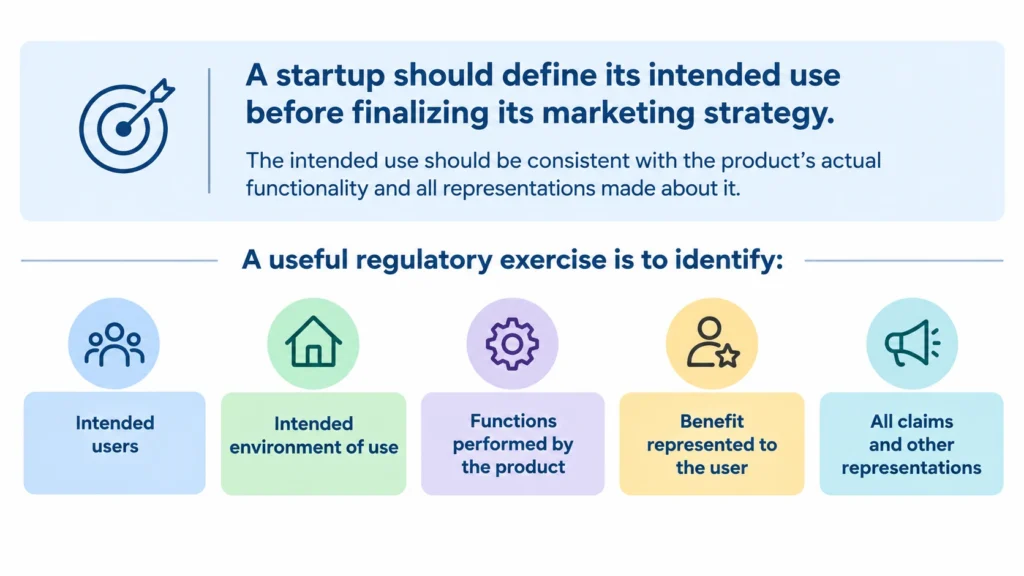
Start with the Intended Use
One of the most important themes throughout the guidance is that regulatory status depends on intended use.
FDA examines what a manufacturer communicates about its product through product labeling, instructions for use, marketing materials, websites, social media content, advertising, public statements, app-store descriptions, educational content, and other promotional communications. Taken together, these materials help establish intended use.
For this reason, successful wellness companies increasingly view claims governance as a strategic function rather than simply a marketing review exercise.
General Wellness Does Not mean FDA Exempt
This is one of the most important points for founders.
FDA’s General Wellness policy is a compliance policy. For products within the policy, FDA states that it does not intend to examine whether they are devices or, if they are devices, whether they comply with certain device requirements, including applicable premarket and post-market requirements.
This should not be described broadly as an FDA exemption.
The distinction is particularly important because there is also a separate statutory provision concerning certain software functions.
Section 520(o)(1)(B) is Different
Section 520(o)(1)(B) of the FD&C Act provides a statutory exclusion for certain software functions intended to maintain or encourage a healthy lifestyle, when they are unrelated to the diagnosis, cure, mitigation, prevention, or treatment of a disease or condition. A software function meeting these criteria is excluded from the statutory definition of a device.
This should be distinguished from FDA’s General Wellness: Policy for Low Risk Devices.
For a product that combines hardware and software, the Section 520(o)(1)(B) exclusion applies to the qualifying software function, not automatically to the entire product. The developer should therefore consider the hardware, relevant software functions, intended use, claims, and associated risks when determining the appropriate FDA framework.
This distinction is particularly relevant to wearables, sensors, connected products, and other products incorporating software, where different components or functions may have different regulatory status.
The Product Must Also be Low-risk
A general wellness purpose is not sufficient by itself. FDA’s policy applies to low-risk products.
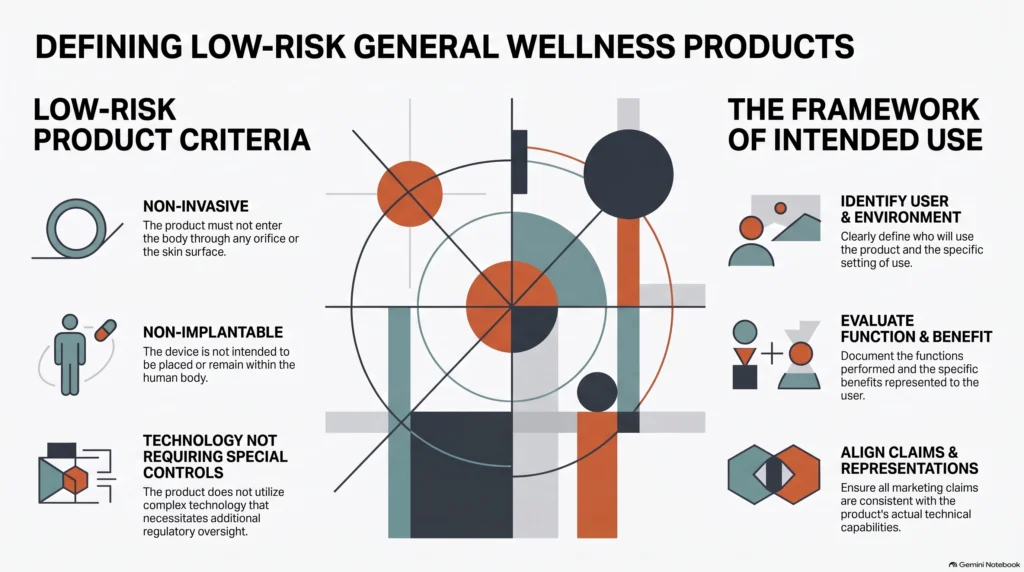
FDA gives technologies such as lasers and radiation exposure as examples of potential risk considerations.
It is important to note that classification as a Class I device does not necessarily mean that a product is low risk for purposes of the General Wellness policy.
Therefore, innovators should conduct a product-specific risk assessment rather than relying on the product’s device classification, consumer positioning, or intended environment of use.
Consumer Use Does Not Automatically Mean General Wellness
Another common misconception is that direct-to-consumer sales automatically qualify a product as a general wellness product. That conclusion does not follow. FDA recognizes that over-the-counter products can contain software functions that are devices and may remain subject to FDA’s device regulatory oversight. FDA specifically directs manufacturers to consider the applicable device and digital-health policies when assessing OTC software and connected products. The regulatory analysis always remains product-specific.
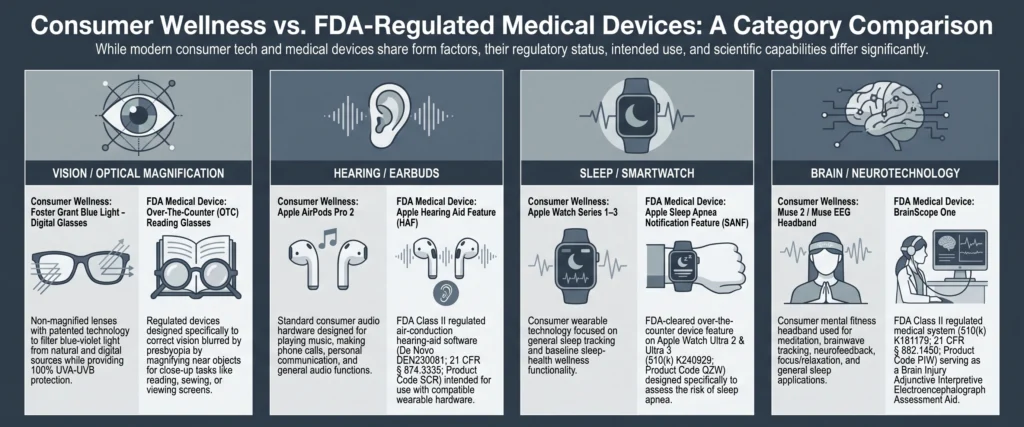
Understanding the Difference
Conclusion
FDA’s General Wellness: Policy for Low-Risk Devices is not a shortcut around device regulation. Rather, it provides a carefully defined regulatory framework for low-risk products intended to promote healthier lifestyles.
As AI-enabled applications, connected wearables, and consumer health technologies continue to evolve, companies will increasingly need to answer a fundamental question:
Are we building a wellness product, or are we building a medical device?
The answer will depend less on branding and more on intended use, product risk, and the claims made throughout the product’s commercial ecosystem. Companies that understand that distinction early will be far better positioned to navigate FDA expectations and scale successfully.
Insights from the MedTech Guru
Q1. Can foreign marketing claims affect the U.S. General Wellness analysis?
A. The relevant question is the product’s U.S. intended use. Foreign-language or foreign-market materials do not automatically establish U.S. intended use merely because they exist elsewhere.
However, materials marketed to the U.S. market or consumers can be relevant evidence of intended use. Accordingly, companies should maintain consistency between their U.S. labeling, promotional materials, distributor guidance, and claims strategy.
Q2. Does the absence of a medical claim guarantee General Wellness status?
A. No. Avoiding medical terminology is important but not sufficient. A product cannot become a general wellness product simply by replacing medical terminology with softer language if its underlying intended use remains medical.
FDA’s framework also considers whether the product is low risk and whether its intended use fits within the applicable General Wellness Policy.
Upcoming Events – Oct 2026
European Medical Device & Diagnostics Quality Assurance & Regulatory Affairs Conference 2026. October 6–8, 2026, Amsterdam, Netherlands, Europe.
Regulatory and quality-focused medical-device conference covering global regulatory control, compliance, inspections, quality assurance, post-market surveillance, and vigilance. [Link]
European Medical Device Cybersecurity Conference 2026. October 13-15, 2026, Boston, USA.
Specialized medical-device cybersecurity conference covering cybersecurity strategy, regulatory expectations, security engineering, risk management, and emerging requirements affecting connected medical devices. [Link]
The MedTech Conference 2026. October 18–21, 2026, Boston, Massachusetts, USA.
Major global medtech industry conference hosted by AdvaMed, bringing together medical-device, diagnostic, and digital-health companies and addressing regulatory, market access, innovation, commercial, and industry-policy topics. [Link]
TOPRA Symposium 2026. October 19–21, 2026, Utrecht, Netherlands.
Regulatory-affairs conference bringing together regulatory professionals and industry experts to discuss current developments and practical issues affecting the medicines and medical-device regulatory environment. [Link]
How Can BLA Regulatory Help?
BLA Regulatory, LLC operates as a global regulatory consulting firm specializing in medical device and biopharmaceutical compliance and submission support. Our regulatory experts help innovators and medical device manufacturers assess their product categorization, and develop FDA-aligned submissions.
BLA Regulatory serves clients across the U.S., Europe, China, and Japan, helping bring safe and effective innovations to market with speed and reliability. For more insights, visit: https://bla-regulatory.com/
Stay in Orbit
Subscribe to future issues of MedTech Orbit for practical updates, U.S. FDA device regulations, and smarter compliance strategies, delivered straight to your inbox.