Beyond the IDE: Building a Clinical Evidence Strategy That De-Risks Medtech Startups
August 27, 2026

For many medtech startups, obtaining an Investigational Device Exemption (IDE) is viewed as a major milestone. It may unlock first-in-human studies, support fundraising discussions, and signal progress toward commercialization. Yet some of the most expensive mistakes in medical device development occur after the IDE is obtained.
An IDE allows an investigational medical device to be used in a clinical study to collect safety and effectiveness data. FDA’s IDE framework also establishes requirements for human subject protection, informed consent, study oversight, monitoring, records, and reporting. The challenge is that IDE approval does not guarantee that a study will generate evidence suitable for a future regulatory submission. A study can be approved, activated, fully enrolled, and completed, yet still leave critical questions unanswered. The result can be additional clinical work, delayed timelines, increased capital requirements, and uncertainty regarding the regulatory path forward.
The most successful medtech companies therefore approach clinical development differently. Rather than treating the IDE as the objective, they treat it as one component of a broader clinical evidence strategy. The focus shifts from “How do we obtain IDE approval?” to “What evidence do we need to generate, and how do we build a clinical program capable of producing it?”
That distinction can determine whether a clinical study becomes a value-creating milestone or an expensive learning exercise.
Start With the End in Mind
One of the most common mistakes in clinical development is treating study design as the starting point rather than the outcome of a broader evidence strategy.
Before discussing endpoints, sample size, or enrollment targets, sponsors should be able to answer several fundamental questions:
-
- What claim will the eventual regulatory submission seek to support?
- Which patients are intended to benefit from the technology?
- What evidence will be required to support that claim?
- What safety risks must be characterized?
- What outcomes will be meaningful to regulators, clinicians, and other stakeholders?
- Which regulatory pathway is anticipated?
The strongest clinical programs are designed backward from the decision they are intended to support.
Too often, sponsors focus on completing a study rather than ensuring that the resulting evidence will answer the questions FDA is likely to ask. A study can be successfully executed, fully enrolled, and statistically analyzed yet still generate limited regulatory value if it was not built around the right evidence objectives.
The goal is not simply to run a clinical trial. The goal is to generate evidence that meaningfully reduces uncertainty around the safety, performance, and intended use of the device.
Does the Study Require an IDE? Understanding SR vs NSR
FDA defines a Significant Risk (SR) device as one that presents a potential for serious risk to the health, safety, or welfare of a subject. The determination is based on the device under investigation and its proposed use, and not simply its novelty, technology, or device classification.
For a Non–Significant Risk (NSR) investigation, the Institutional Review Board (IRB) makes the initial risk determination. If the IRB agrees that the study is NSR and approves it, an FDA IDE application generally is not required. If the IRB determines that the investigation is SR, the sponsor must obtain FDA approval via IDE before the study begins.
Clinical Readiness Starts with the Device
Before initiating a clinical investigation, the device should be sufficiently characterized for the proposed study.
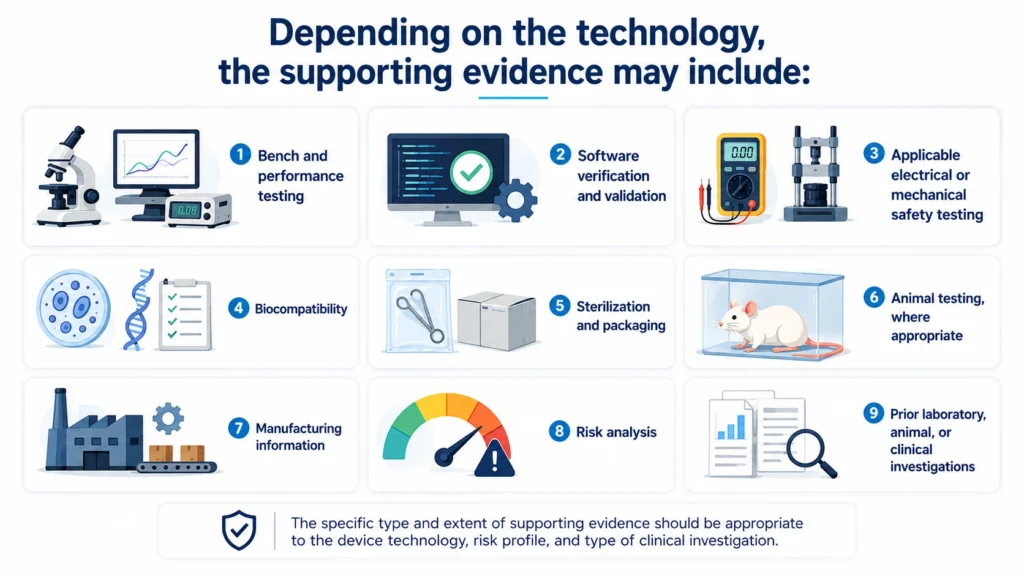
There is no universal testing package applicable to every device. The appropriate evidence depends on the device, its characteristics, intended use, risk profile, and proposed investigation.
The IDE submission generally includes:
-
- Sponsor and device information- sponsor, manufacturer, device name, intended use, and relevant contacts.
- Prior investigations– comprehensive reports of prior clinical, animal, and laboratory testing, including relevant publications and adverse information.
- Investigational plan- study purpose, protocol, statistical methodology, risk analysis, patient population, monitoring procedures, and required records/reports.
- Device description- components, materials, specifications, principle of operation, and anticipated changes during the investigation.
- Manufacturing information- methods, facilities, and controls for manufacturing, processing, packaging, storage, and installation.
- Investigator information- investigator agreements, investigator list, and required certifications.
- IRB information- participating IRBs, their actions, and applicable institutional information.
- Labeling and informed consent materials- investigational labeling and all materials provided to study participants.
- Other supporting information- applicable FDA correspondence, waiver requests, referenced FDA files, and information specifically requested by FDA.
Sponsors sometimes think of these items as a filing checklist. In reality, they represent a scientific evidence package supporting clinical investigation. The device description, risk analysis, nonclinical testing, manufacturing information, clinical protocol, investigator materials, and informed consent documents should align with one another.
Collectively, they should support a consistent rationale for why the device is ready to be evaluated in human subjects. FDA states that the sponsor must provide reason to believe that the risks are outweighed by the anticipated benefits or importance of the knowledge to be gained, that the investigation is scientifically sound, and that there is reason to believe the device will be effective as proposed.
Designing Clinical Studies for Regulatory Success
Once device readiness has been established, the next question is whether the proposed investigation will generate evidence capable of supporting future decisions.
Clinical investigations are commonly conducted to support PMA applications, but clinical studies may also support other regulatory purposes, including certain modifications or new intended uses of legally marketed devices.
Before finalizing the protocol, the sponsor should be able to defend:
-
- Why the selected population is appropriate
- Why the endpoint addresses the relevant clinical question
- Why the comparator is appropriate, where applicable
- Why the statistical design is appropriate
- How the resulting evidence is expected to inform the intended regulatory submission
Calling a study pivotal does not, by itself, establish that it will be sufficient for a marketing application.
Optimize for Scientific Defensibility, not Enrollment Size
There is no universal FDA minimum sample size for IDE studies.
Sample size should be justified according to the study design and relevant statistical assumptions, which may include the endpoint, expected performance or treatment effect, variability or event rate, statistical power, significance level, and other study-specific factors.
Reducing enrollment at the expense of statistical or clinical validity can create greater downstream cost if the resulting evidence is inconclusive.
Engage with FDA Sooner rather than Later
Many startups engage FDA only when the IDE application is nearly complete. In practice, earlier interaction can often prevent costly delays and study redesigns.
FDA’s Q-Submission Program provides a mechanism for sponsors to request feedback on planned submissions and development strategies.
A Pre-Submission may be particularly useful when sponsors seek feedback regarding:
-
- The overall clinical-development strategy
- The sufficiency of a nonclinical test program
- A first-in-human investigation
- An early feasibility study
- Proposed endpoints or control groups
- Sample-size or statistical assumptions
- Duration of follow-up
- A novel test method
- The use of non-U.S. clinical data
- A new or complex technology
The most useful questions are specific and decision-oriented. Instead of asking whether the entire development program is acceptable, sponsors should identify the issue, present the relevant evidence and rationale, state the proposed approach, and ask FDA to comment on that approach.
The most valuable FDA interactions often occur before major developmental decisions become locked into a protocol, budget, or investor timeline. FDA feedback through the Q-Submission Program is generally nonbinding. If the device, evidence package, indication, or study design changes materially, earlier feedback may need to be revisited.
30-Day IDE Review is Only One Timeline Milestone
For an SR investigation, FDA may approve, approve with conditions, or disapprove an IDE application. An IDE application is considered approved 30 days after FDA receives it unless FDA informs the sponsor otherwise within that period. The investigation may begin only after the applicable FDA and IRB requirements have been satisfied.
Accordingly, 30 days should not be presented as an IDE-to-first-patient timeline.
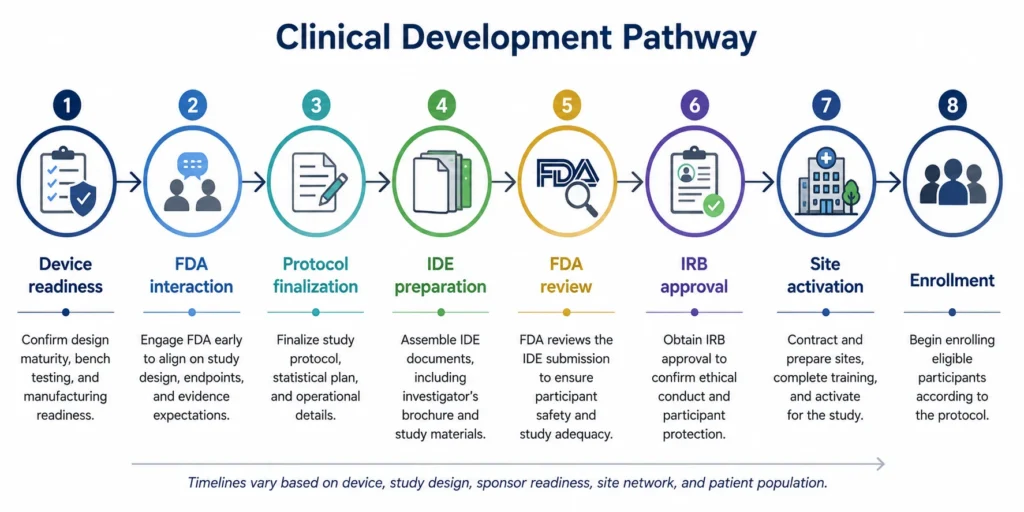
The actual timelines that are relevant for management and the investors, depend on the device, study design, sponsor readiness, site requirements, and patient population.
Budget for the Evidence Milestone
There is currently no FDA user fee for an IDE application, though the eventual PMA/De Novo submission can carry a significant FDA user fee. Also, the clinical program itself can require significant investment, including:
-
- nonclinical testing;
- regulatory and clinical strategy;
- protocol and biostatistics;
- investigational device manufacturing;
- CRO and clinical-site activities;
- IRB review;
- monitoring;
- data management;
- statistical analysis; and
- quality and clinical operations.
There is no meaningful universal cost for an IDE study. Costs vary substantially with study design, enrollment, number of sites, follow-up, device complexity, and operating model.
For investors, the more useful question is what capital is required to reach the next meaningful clinical milestone, what assumptions drive that estimate, and what contingency exists if those assumptions change?
This connects financing to evidence generation rather than to the submission itself.
Conclusion
Evidence Is the Asset.
A well-designed IDE program brings together regulatory strategy, clinical science, product readiness, operational execution, and capital planning.
The strongest medtech companies understand that these are not separate workstreams. A change in intended use can change the clinical study. A change in the study can change enrollment and cost. A device-development gap can delay the entire program. And a study that produces inadequate evidence can create the need for additional clinical work.
The objective is therefore bigger than obtaining IDE approval.
Insights from the MedTech Guru
Q: What if FDA approves our IDE, but the study is incapable of supporting our PMA?
A: IDE approval means FDA agrees the investigation may proceed. It does not mean FDA has agreed that the resulting evidence will support marketing authorization. Design the study backward from the PMA decision, not forward from the IDE.
Q: What is the one clinical-design decision that can become impossible to fix later?
A: Choosing the wrong patient population. A study can be flawlessly executed yet generate limited regulatory value if the enrolled population does not adequately represent the patients covered by the proposed intended use.
Q: What if our device changes during the clinical trial?
A: This can create an evidence-continuity problem. If the marketed device differs materially from the device studied, FDA may question whether the clinical data remain applicable. Lock the device configuration and define change-control rules before pivotal enrolment.
Q: When should a startup not submit its IDE?
A: When it cannot clearly answer three questions: What exactly are we claiming? Who are we claiming it for? And what evidence will prove that claim? If those answers are still moving, submitting the IDE may lock the company into an expensive study before the strategy is mature.
Upcoming Events – August 2026
MassMEDIC Regulatory, Payment and Policy Conference. September 9, 2026, Boston, Massachusetts, USA.
MedTech-focused conference covering regulatory strategy, FDA pathways, risk mitigation, policy developments, MDUFA VI, and Medicare Advantage oversight. [Link]
RAPS Convergence 2026. September 15-17, 2026, Charlotte, North Carolina, USA.
Major regulatory affairs conference bringing together regulators, industry, clinical, and academic stakeholders to address evolving regulatory requirements, healthcare product development, and regulatory strategy. [Link]
AdvaMed Medtech Showcase. September 16, 2026, USA.
An interactive event on Capitol Hill featuring more than 25 medtech companies and their groundbreaking innovations, bringing innovative and breakthrough medical technologies directly to policymakers. [Link]
FDA/MDIC Regulatory Science Innovations Catalyzing Medical Device Development. September 25, 2026, Silver Spring, Maryland, USA.
FDA-MDIC public meeting focused on regulatory science challenges affecting breakthrough and disruptive medical devices, emerging technologies, clinical scenarios, and future priorities for medical device development. [Link]
How Can BLA Regulatory Help?
BLA Regulatory, LLC operates as a global regulatory consulting firm specializing in medical device and biopharmaceutical compliance and submission support. Our clinical regulatory experts help medical device manufacturers assess IDE requirements, determine SR/NSR status, and develop FDA-aligned clinical investigation strategies and IDE submissions. By addressing regulatory and evidence requirements early, we help reduce avoidable delays and strengthen the path to clinical development and subsequent regulatory submission.
BLA Regulatory serves clients across the U.S., Europe, China, and Japan, helping bring safe and effective innovations to market with speed and reliability. For more insights, visit: https://bla-regulatory.com/
Stay in Orbit
Subscribe to future issues of MedTech Orbit for practical updates, U.S. FDA device regulations, and smarter compliance strategies, delivered straight to your inbox.