
U.S. FDA ARC Program: 6 Strategic Signals for Rare Disease Sponsors
August 20, 2026

Rare disease drug development often requires sponsors to generate persuasive evidence in small, heterogeneous populations where natural history is limited, endpoints may lack precedent, and conventional trial designs may not be feasible.
To address these systemic bottlenecks, FDA launched the Accelerating Rare Disease Cures Program, or ARC, through CDER in May 2022 to help speed up and increase the development of safe and effective treatment options for patients with rare diseases.
For sponsors, the ARC Program should be understood as CDER’s rare disease regulatory innovation framework, not as a new approval pathway, orphan designation, grant portal, or shortcut around evidentiary standards. Its practical value is that it shows where FDA is investing scientific and regulatory effort: disease understanding, endpoint development, small-population trial design, confirmatory evidence, translational science, dose optimization, and focused communication for rare disease programs.
The Program does not lower the approval bar. It signals where global rare-disease sponsors should strengthen their strategy and planning before pivotal development.
What Exactly Is ARC?
Rather than acting as a traditional review division, the ARC Program functions as a strategic umbrella and incubator within the FDA. It drives scientific and regulatory innovation by fostering internal and external partnerships, engaging with academic and industry experts, and creating specialized pilot programs that provide sponsors with extensive regulatory guidance for rare disease development.
The Program aims to solve the core challenges of rare disease development by equipping sponsors with the tools and early feedback necessary to design viable clinical and CMC strategies.
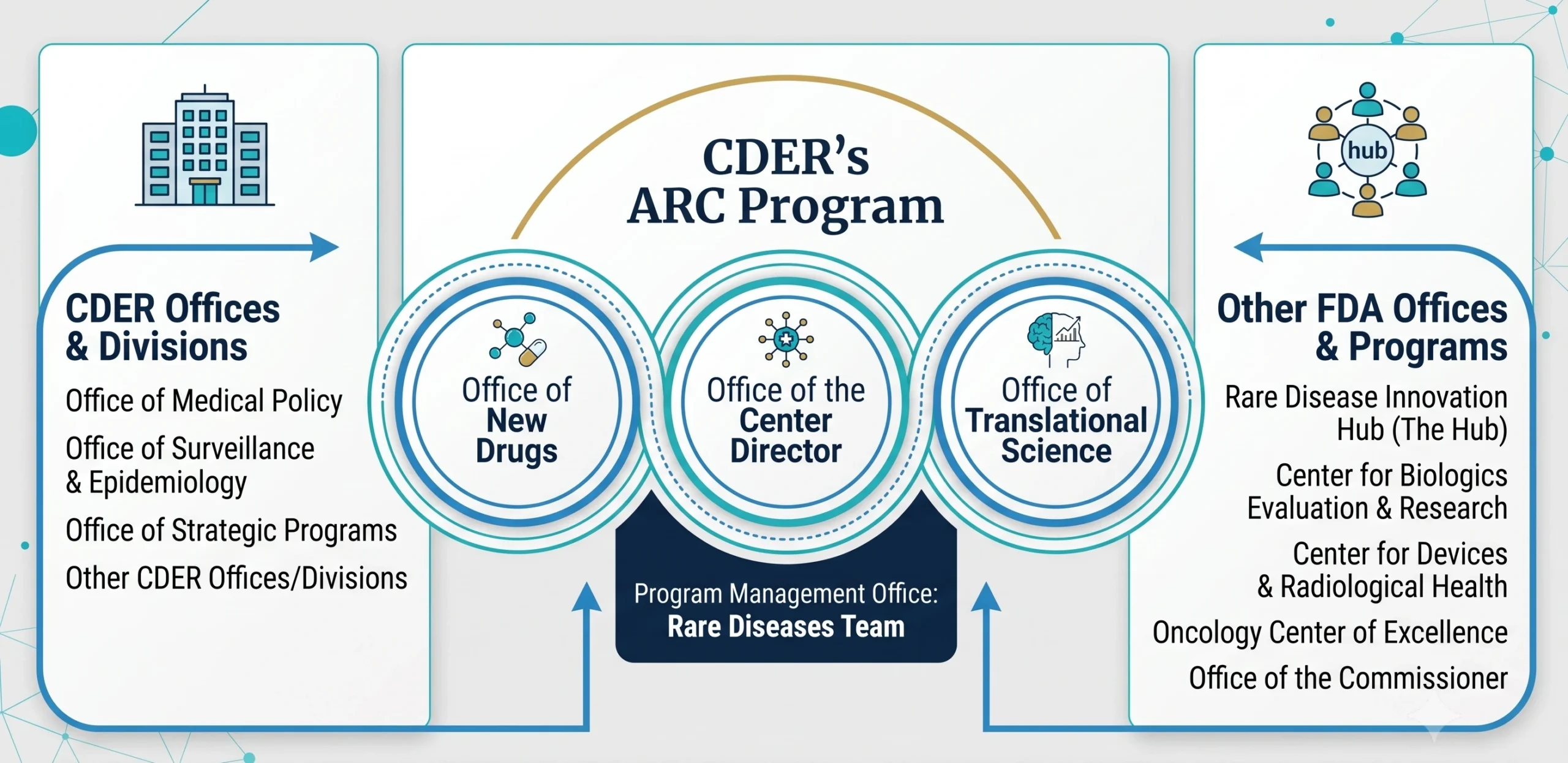
One of ARC Program’s most significant recent developments is the Rare Disease Innovation Hub (RDIH), formally launched by FDA in Oct 2024. The Hub was created to strengthen collaboration between CDER and CBER and improve consistency in the development and review of rare disease products across therapeutic modalities, including small molecules, biologics, cell therapies, and gene therapies. The RDIH released its Strategic Agenda in February 2026, outlining priorities including regulatory science, cross-center alignment, and a centralized point of engagement with the rare disease community.
For sponsors, the significance of the Hub lies less in a new application process and more in its potential to promote greater cross-center alignment on scientific, clinical, and regulatory issues.
What Should Sponsors Practically Know About the ARC Program?
1. Start With the Disease, Not the Protocol
Rare disease sponsors should begin with the disease evidence base before locking in the clinical protocol.
Sponsors should be prepared to explain:
-
- Disease course
- Target population
- Phenotype or genotype variability
- Expected progression
- Meaningful symptoms or functional impacts
- Evidence supporting the proposed development population
Natural history data can help justify endpoint selection, contextualize treatment effect, support external control considerations, or explain why a conventional randomized trial may be difficult. ARC program-supported regulatory analysis also emphasizes disease modeling and the generation of fit-for-purpose evidence.
2. Treat Endpoint Strategy as an Early Regulatory Risk
Endpoint strategy is often the central regulatory risk in rare disease programs. ARC activities include developing, testing, and validating methodologies for novel endpoints that better capture meaningful change in rare disease clinical trials.
FDA’s recent external analysis has examined pivotal trial characteristics underlying rare disease drug approvals between 2013 and 2022. The analysis found that both biomarkers and clinical outcomes were commonly used as primary efficacy endpoints in rare disease trials. The choice of primary endpoint selection varied by therapeutic area, approval pathway, and the level of understanding of disease etiology.
Sponsors should address endpoint risk early, particularly when relying on novel, modified, surrogate, biomarker-based, or patient-reported endpoints. The endpoint rationale should explain clinical meaningfulness, measurement reliability, interpretability, missing data considerations, and alignment with the disease’s natural history.
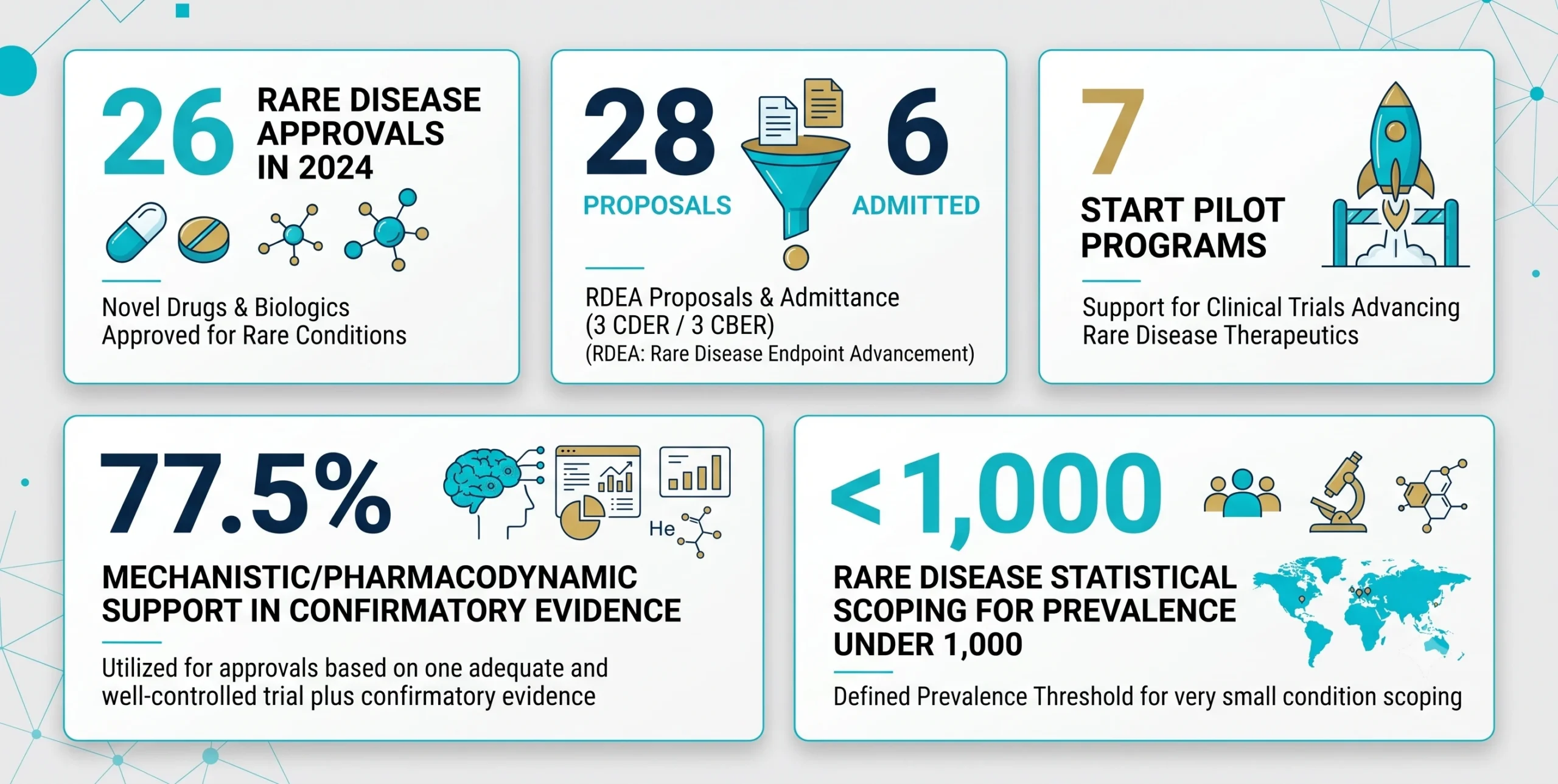
The Rare Disease Endpoint Advancement Pilot Program, or RDEA, launched in Oct 2022, is one example of FDA’s focus on this issue. RDEA supports novel efficacy endpoint development for rare disease therapies and allows selected sponsors to interact with interdisciplinary FDA experts through up to four focused meetings on the proposed endpoint. Under the current PDUFA VII authorization, FDA accepts up to one RDEA proposal per quarter, with a maximum of three admissions per fiscal year. Sponsors may submit proposals through June 30, 2027. As of May 2026, FDA has received approximately 28 RDEA proposals and admitted six into the program (three CDER and three CBER).
3. Flexible Evidence Requires Stronger Planning
The ARC Program reflects FDA’s recognition that rare disease evidence may need to be generated differently when large, conventional trials are not feasible. It does not mean FDA will accept weak evidence.
The ARC Program highlights FDA research on rare disease applications that use one adequate and well-controlled trial plus confirmatory evidence to meet the substantial evidence standard. An FDA analysis of non-oncologic rare disease marketing applications approved between 2020 and 2023 found that mechanistic or pharmacodynamic evidence supported 77.5% of applications approved based on one adequate and well-controlled trial plus confirmatory evidence.
For sponsors, each evidence source should have a defined role. If a program relies on biomarkers, pharmacodynamic data, nonclinical models, natural history data, external controls, expanded access data, or confirmatory evidence, the submission strategy should clearly explain how each component contributes to the overall evidence package and how the totality of evidence supports a determination of substantial evidence of effectiveness.
4. Small-Population Trial Design Must Be Built in Early
Small patient populations can restrict trial design options, reduce statistical power, and complicate interpretation. FDA identified small populations as one of the core reasons rare disease development is complex when the ARC Program was launched. https://www.fda.gov/drugs/drug-safety-and-availability/cder-launches-new-accelerating-rare-disease-cures-arc-program
CDER’s Office of Biostatistics has worked on rare disease-specific statistical methods, including a best-practice document for statistical reviewers addressing non-traditional study designs and innovative approaches. CDER is also initiating Rare Disease Scoping Meetings for statistical reviewers, with original protocols for diseases involving very small populations, including prevalence below 1,000, expected to be brought for discussion during initial implementation.
The Rare Disease Drug Development Design, or RD4, Workgroup focuses on trial design and analysis challenges common in small populations. RD4 has explored approaches such as proportional odds models, ordinal Markov modeling, and longitudinal data analysis.
Non-traditional trial design should not be introduced as a late rescue strategy. Sponsors should assess feasibility, interpretability, endpoint behavior, control strategy, missing data, treatment duration, and statistical assumptions early.
5. START Shows FDA’s Interest in Focused Communication
The Support for Clinical Trials Advancing Rare Disease Therapeutics, or START Pilot Program, launched in Sep 2023, is one of the clearest examples of how FDA is testing more intensive interaction models for selected rare disease programs.
START is a joint CDER and CBER pilot, where selected participants can receive frequent advice and enhanced communication from FDA staff on program-specific development issues, including clinical study design, choice of control group, patient population, use of nonclinical information, and product characterization.
6. Translational Science and Dose Rationale Matter Earlier
Rare disease programs often depend on a strong biological rationale, early clinical pharmacology, biomarker evidence, and dose justification.
FDA has emphasized that translational studies and clinical pharmacology assessments are critical to support drug efficacy and safety evaluations, identify doses for trials and clinical use, and individualize therapy based on patient-specific factors. FDA has also focused on dose-finding and optimization for rare disease drugs, including challenges in small patient populations and novel approaches to inform dose selection.
Recent ARC Program regulatory science efforts have focused on biomarkers in specific diseases, first-in-human trials of oligonucleotide therapeutics, enzyme replacement therapies, confirmatory evidence, pediatric considerations, artificial intelligence or machine learning in sickle cell disease, and new approach methods such as microphysiological systems.
For sponsors, dose selection, translational rationale, and biomarker strategy should be integrated into regulatory planning early.
Regulatory Rare Disease Statistics and Program Data
Source: 2025 ARC Annual Report
How Should Sponsors Use ARC in Regulatory Planning?
Sponsors should treat ARC as a planning lens:
-
- Build the disease evidence base early, including natural history, patient heterogeneity, disease progression, and patient-relevant outcomes.
- Resolve major endpoint questions before pivotal trial design.
- Build a totality-of-evidence narrative, with each evidence source assigned a clear regulatory purpose.
- Align clinical, statistical, CMC, nonclinical, translational, and regulatory functions before FDA engagement.
Engage with FDA early in development
How can BLA Regulatory help?
Rare disease programs often face unique regulatory challenges as mentioned above. BLA Regulatory helps sponsors navigate these complexities through:
-
- Development of rare disease regulatory strategies aligned with FDA expectations
- Regulatory gap assessments and evidence-planning support
- FDA meeting strategy, briefing package preparation, and meeting support
- IND-enabling, clinical, nonclinical, and CMC regulatory planning
- Cross-functional alignment of development activities with future NDA or BLA requirements
- Regulatory intelligence to support endpoint, trial design, and approval pathway decisions
Our approach is built around helping sponsors identify key regulatory risks early and develop practical strategies to support efficient product development and future marketing applications.
This newsletter is for informational purposes only and does not constitute formal legal or regulatory advice.